Lithuania’s technological readiness assessed: the weakest link surprised even the index creators

November 4, 2026

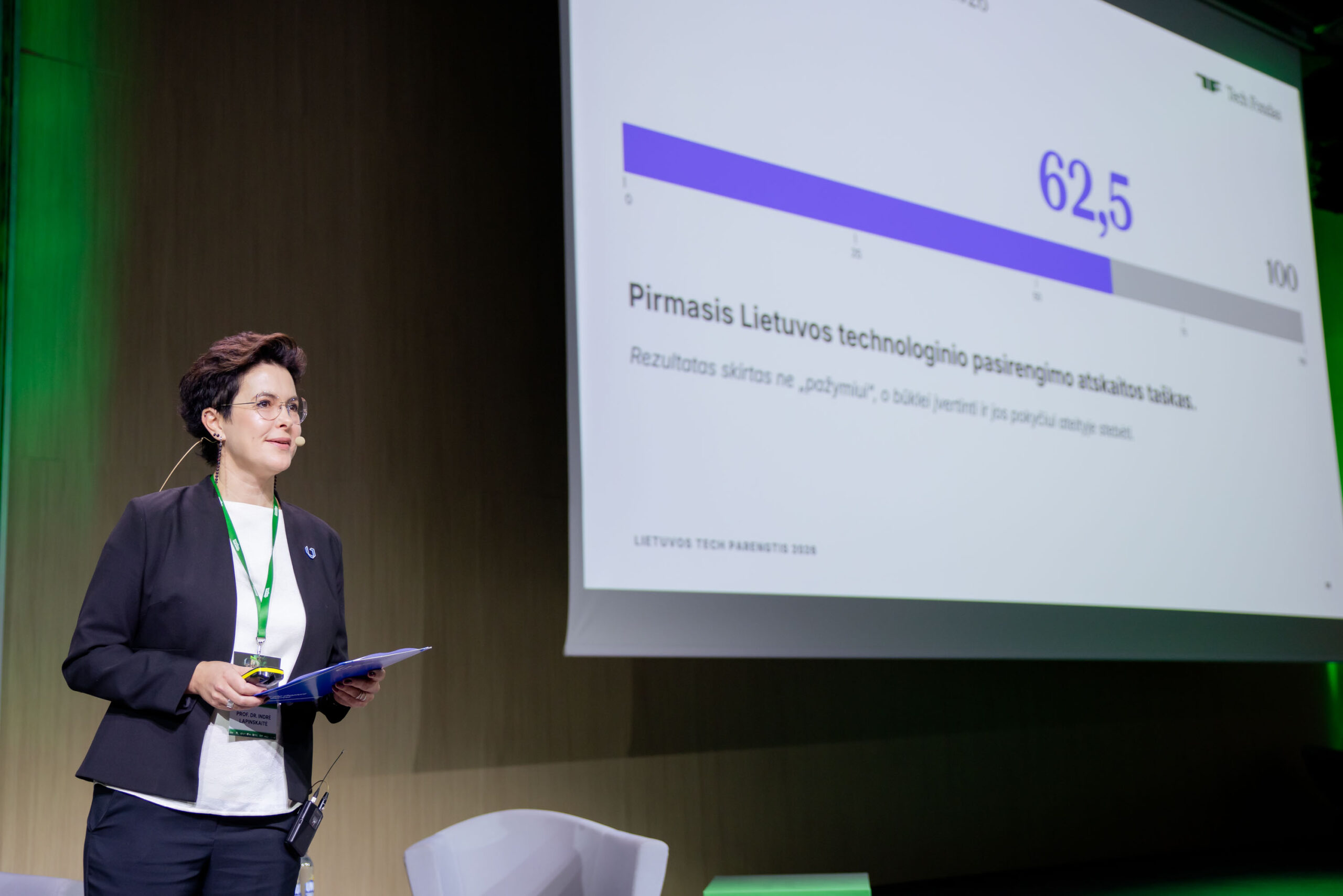
Lithuania’s technological readiness has been evaluated at 62.5 out of 100 points. However, according to the creators of this pilot index, this number is not a grade given to the state. It is a baseline that will allow tracking whether Lithuania will be better able to nurture tech talent, strengthen resilience, and turn scientific knowledge into market-ready products in the future.

Behind the overall score lies an uneven picture. The cybersecurity and information resilience dimension scored 71 points, talent and future competencies scored 64.6, while the potential for innovation and science commercialization reached just 52 points. The 19-point gap between the highest- and lowest-rated dimensions revealed Lithuania’s uneven technological readiness.

The pilot “Lithuanian Tech Readiness 2026” index was presented at the “Security Code” (Saugumo kodas) conference, organized by the news portal Lrytas, by Prof. Dr. Indrė Lapinskaitė, Director of the Dynamic Management Institute at VILNIUS TECH.

The Index Consists of 45 Indicators

Lapinskaitė asked the audience whether Lithuania is prepared for a technological future. In her view, most people would choose the third answer: “I don’t know.” The speaker admitted she did not know either until she and her team began developing the index, analyzing data, and looking for answers.

It turned out that a country’s technological readiness cannot be measured by just one or two indicators. Standalone metrics—such as the scale of R&D investments, the number of startups, or cybersecurity indices—do not provide a complete answer. Therefore, technological readiness was evaluated as a system of three interrelated dimensions.

The first dimension is talent: Lithuania needs people capable of developing, implementing, and applying technology. The second encompasses the state’s ability to operate securely and remain resilient in a technological environment. The third is commercialization—the ability to turn created knowledge and technologies into end products and economic value.

“Technological readiness depends on all three dimensions combined and their mutual interaction,” emphasized the Director of the Dynamic Management Institute at VILNIUS TECH.

Each of the three dimensions was allocated 15 indicators, making a total of 45 indicators for the index. Their selection was based on three evaluation principles: advancement, adaptability, and foresight. The goal was to assess where Lithuania stands today, how it responds to changes, and what future potential it is creating.

The selected indicators were evaluated by 40 experts across various sectors and fields of expertise. 35% of the evaluators represented higher education and research, 25% came from the public sector, another 25% from associations and the innovation ecosystem, and 15% represented business.

The experts were asked to individually assess the importance of each indicator within a specific dimension and establish the benchmark for high readiness. The results of the three sub-indices were then combined into an overall technological readiness index for Lithuania.

62.5 Points – Not a Grade for Lithuania

Following the calculations, the “Lithuanian Tech Readiness 2026” index reached 62.5 out of 100 points. I. Lapinskaitė admitted that this number surprised even the creators of the index, but stressed that this result should not be viewed as a final grade for Lithuania.

“This result is not a grade for Lithuania. It is the initial reference point from which we will now be able to observe and assess the changes in technological readiness in the future,” the professor said.

The index is not intended to compare Lithuania with other countries or to create an international ranking. Its purpose is to monitor the domestic state of affairs and its progress over time. Therefore, the first result is significant not only for the overall score, but also for the disparities between its three constituent areas.

The talent sub-index scored 64.6 points. In this area, experts highlighted the problem of continuity along the tech talent pipeline, which is particularly acute in its early stages. “Early STEM education is becoming a kind of bottleneck for the entire technology pipeline,” I. Lapinskaitė quoted one of the experts.

The speaker’s message regarding this dimension was clear: the development of talent and competencies required for a technological future must be strengthened as early as school.

The highest-rated dimension was cybersecurity and information resilience, scoring 71 points. Nevertheless, even here, experts noted an important difference between formal compliance and actual resilience. According to I. Lapinskaitė, it is not enough to have plans, measures, and procedures. The essential question is whether and how all of this will work when facing a real threat. “True resilience is demonstrated in practice, not on paper,” she summarized.

The commercialization sub-index scored 52 points. This is the lowest of the three results, and its low score also surprised the index creators, according to I. Lapinskaitė.

Experts in this field pointed out a striking gap between what Lithuania can create in terms of knowledge and technology, and what it actually manages to convert into products, exports, or investments.

“It is not enough to create knowledge—we must be able to convert it into economic value,” said the Director of the Dynamic Management Institute at VILNIUS TECH.

This is where it becomes most evident why technological readiness cannot be judged in isolation. Even with ample knowledge and technological solutions, overall readiness depends on whether they make it all the way to the market.

Combining the results of all three sub-indices and expert insights revealed three strategic directions: First, educate and develop, ensuring the country has a cohesive talent pipeline. Second, protect, ensuring that readiness is real, not just formal. Third, commercialize, shortening the path from scientific results to the market.

“Technological readiness is not just a collection of separate measures lumped together. It is the ability of the entire chain to function together as one,” I. Lapinskaitė said.

The professor reiterated that the presented index is a pilot project. Nevertheless, it already reveals the system’s strongest and weakest links, enabling future tracking of where and how fast Lithuania is moving forward.

The First Step – A Cybersecurity Model

Technological resilience comes down to our decisions, the people we educate, and the competencies we invest in. What can we do in Lithuania today so that Lithuania’s technological readiness scores higher next time?

VILNIUS TECH has established the “Tech Fund” (Tech Fondas), aligning its role with three directions: The first is technological talent, as professionals are required to build and apply technologies. The second is technological resilience, ensuring that knowledge created in universities solves real-world challenges in Lithuania. The third is technological breakthrough, helping laboratory innovations turn into market-ready products.

The Tech Fund is taking its first concrete step in cybersecurity. A model is being developed where students, together with academic supervisors and business mentors, will solve real-world organizational challenges.

The goal over the next five to ten years is to improve this index score. The Tech Fund will contribute through talent, cyber resilience, and technological breakthroughs.

“The most important question is no longer what our result is today, but whether we will be better prepared next time,” concluded Prof. Dr. I. Lapinskaitė.

Galerija
Related news

In the age of content-generating artificial intelligence, who is the true author of the work?
Take a look at these images. Which one do you think is the most beautiful? Which one is technically better executed? Which were created by a human and which by artificial intelligence (AI)? Click on the image to view it in full size And how would your assessment change if you found out that they were all created by AI? We live in a time when AI is increasingly moving into almost all spaces - from social media campaigns to advertisements, posters and informational visuals. It is quite possible that soon a large proportion of the images we see around will be marked with the words "Created using AI." But does knowing who created an image change the way we perceive it? (But before you continue reading, we will reveal that: image 1 was created by AI, image 2 by Giedre Gedeikyte, image 3 by Lukrecija Jaseviciute, image 4 and 5 by DI, image 6 by Milda Mockūnaite-Vitkiene). A bachelor's thesis research project by Laura Dutkute, a graduate of the VILNIUS TECH Entertainment Production study programme, titled "Consumer Participation in Visual Communication in the Digital Environment: Human and Artificial Intelligence Interaction," revealed that when evaluating visual content, audiences consider not only its aesthetics or quality, but also how and by whom it was created. Nevertheless, although AI is increasingly becoming part of the creative process, the role of the human is still essential. Dutkute, who conducted the research, notes that AI is often presented in society as a competitor to creators. However, the research results reveal a somewhat different reality - audiences primarily see AI as a tool that exists alongside humans. Moreover, information about the use of AI can change the way a person evaluates the work itself. "This means that the label indicating the use of AI is not completely neutral. If for the audience AI has negative connotations, this perception can also be transferred to the work, even if AI's contribution was minor," the graduate explains. One of the most important findings of the research is that AI does not eliminate the role of the human as the creator. It can perform certain parts of the creative process, help generate ideas, create different visual versions or personalise content, but the final decisions still have to be made by a human. Therefore, according to L. Dutkute, the creative process does not become any less human but, in a sense, becomes a more collaborative process where AI can offer numerous options and the human is still the one making a choice, evaluating, modifying and maintaining the creative direction. The creator's own skills become particularly important here. The responses from specialists in the study showed that the outcome is strongly determined by how well a person knows how to use the selected tool. As AI becomes increasingly integrated into the creative process, the user's relationship with content is also changing. For users, it is important to know who the content creator is, how it is presented, where it came from and whether it can be trusted. "With the emergence of AI, users have begun to evaluate content more rather than simply enjoy it. On the other hand, people are not always able to recognise for themselves that visual content was created using AI. Once they learn about its origin, they may change their assessment. Therefore, it is important not only to be able to recognise AI-generated content, but also to improve society's overall AI literacy," says L. Dutkute. The involvement of AI in the creative process inevitably raises the question of what we actually mean by authorship today. If one part of a work is created by a human and another is generated by AI, whose work is it? "AI is not a replacement for the creator; it simply serves as another creative tool – just like Canva, Google or Photoshop. Its use has expanded the possibilities even further while also it placing even greater responsibility on the person who decides what they create with this tool and how they present that work to the audience. Ultimately, the person remains responsible for the final result," she says. Therefore, according to the interviewee, it is important to communicate transparently about AI's contribution. All of this is also changing the nature of work for visual communication specialists. In the future, those who simply know how to use one AI tool or another will become less important than those who understand when to use it, what to entrust to it and how to critically evaluate the result. "Specialists will need to compete with AI less and learn how to integrate it properly into their work more. There will be a greater need for people who can choose the right AI tool, formulate a task, evaluate the result and maintain the creative direction," says Laura. According to the graduate, AI is best viewed not as a tool that will take over the entire creative process, but as an assistant capable of expanding human capabilities.
More
Elsevier Training: Scientific Publishing, Journal Selection and Scopus Insights
We invite VILNIUS TECH students, academic staff, and employees to participate in a series of free online training sessions organized by Elsevier, one of the world's leading providers of scientific publishing and information solutions. During these training sessions, participants will learn how to successfully publish research, choose the most suitable journal for their work, gain insights into Scopus evaluation criteria, and make effective use of advanced scientific information search tools. Elsevier Author Workshop – How to Feel Confident on the Publishing Journey Date and time: November 13 | 13:00 Learn how to navigate the scientific publishing journey, from choosing the right journal to understanding peer review and editorial decisions. The webinar will also explore research ethics, responsible AI use, and Elsevier resources that support researchers at every stage of their work. Registration   Editors Session with Elsevier Date and time: November 18 | 11:30 T In this session, participants will learn how the Scopus database selects and evaluates journals for inclusion, ensuring their quality and reliability. The webinar will cover journal evaluation criteria, the submission process, and key information for journal editors seeking to have their publications indexed in Scopus. Registration   How to Find the Right Journal: Strategies and Tools That Can Help Authors Date and time: November 24 | 11:30 This training session will help researchers identify the most suitable journal for their publication. Participants will learn about key journal selection criteria, how to identify leading journals in their field, and how to use Elsevier tools and solutions to make informed publishing decisions and increase the visibility of their research. Registration   Mastering Scopus Advanced Search Date and time: November 26 | 11:30 This session will introduce advanced Scopus search capabilities, enabling participants to build precise and sophisticated queries using additional search fields and search operators. Attendees will learn how to structure complex searches effectively, make the most of advanced database features, and improve the efficiency and accuracy of scientific information retrieval. Registration
More