Debates regarding immigrants—their numbers and their impact on the labor market and national culture—remain a focal point of discussion across Europe and Lithuania. According to data from the Migration Department, 24,830 foreign nationals have been authorized to arrive for work in Lithuania in 2025, approximately 100 fewer than this year.
Crucially, these quotas do not include high-value-added specialists. According to the Ministry of Economy and Innovation, Lithuania currently faces a shortage of specialists across 85 professions, primarily in IT, engineering, robotics, and chemistry. While the most visible face of migration may be food delivery couriers, others, like Ramil Balaghayev from Azerbaijan, arrived specifically because his home country lacked the necessary infrastructure for cybersecurity studies and employment at the time. Today, he marks six years of professional experience in his field.
Repaying a Debt to the National Economy
Ramil is currently employed at his fifth workplace in Lithuania: the U.S.-based global healthcare solutions company, Cencora. Having received a state scholarship that covered both his tuition and living expenses, he feels a strong sense of responsibility to “repay the debt to the country’s economy.”
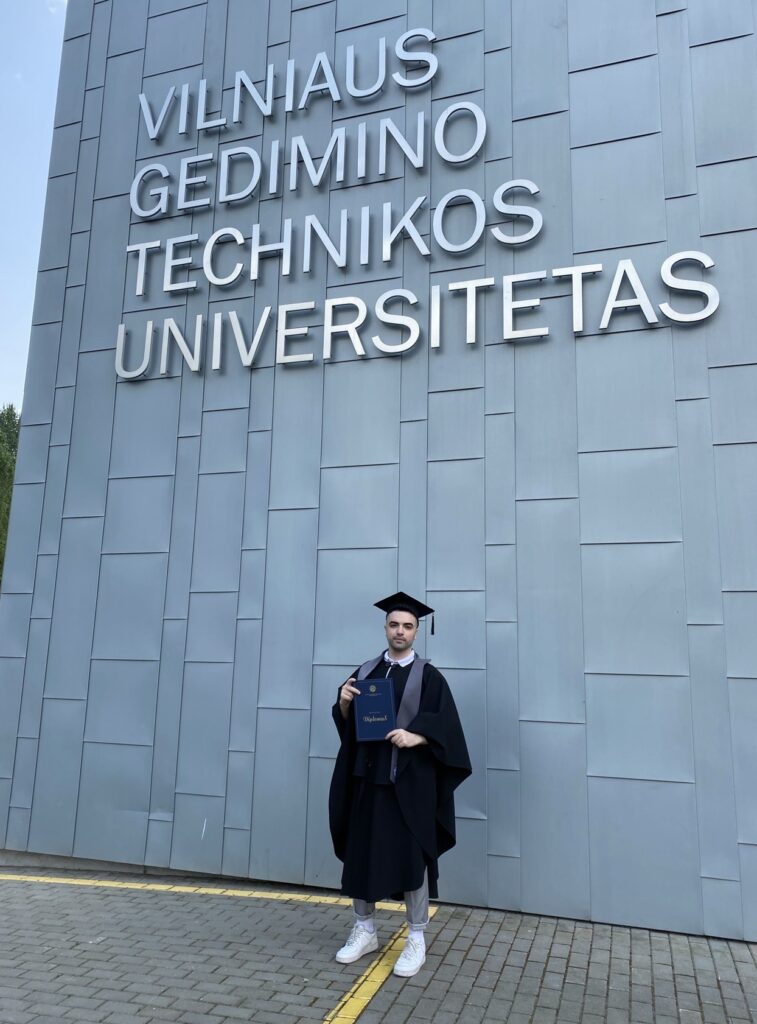
Ramil moved to Lithuania to pursue a Master’s degree in Cybersecurity at VILNIUS TECH, building upon his Bachelor’s degree in Computer Engineering from Baku.
“I wanted to specialize in nanotechnology, network security, and cybersecurity. In 2019, cybersecurity was not yet a prominent field in Azerbaijan, and opportunities for advanced study were limited. I began searching for international universities, with a full scholarship being a primary criterion. This was a challenge, as there was only one state scholarship available for the entire country at that time,” Balaghayev recalls.

Despite 200 to 300 applicants vying for the spot, Ramil secured the scholarship. Shortly after, he received further confirmation from the Education Exchanges Support Foundation regarding a state grant that ensured both free tuition and a monthly stipend.
“I accepted the state’s offer. I had heard positive things about Lithuania from friends and family who had visited the Baltics, but I also conducted my own research. I liked what I found: the country provides quality education, it is safe, and it is experiencing rapid growth in technology and cybersecurity,” says the VILNIUS TECH alumnus.
“If a Family Is Adopting You, You Must Also Put in the Effort”
During his studies, one of Ramil’s professors suggested a summer internship in Rostock, Germany. The Azerbaijani student seized the opportunity to attend a specialized summer school there.
“The following year, I completed my studies, which were highly practical, focusing on areas such as intrusion detection. My thesis explored identifying signs of hacking based on system user behavior,” Balaghayev explains.
After graduating, Ramil began his career as a cybersecurity risk analyst at Baltic Assist. He emphasizes that the knowledge gained at the university allowed for a seamless transition into the workforce, as the professional tasks closely mirrored his academic training.
“The bigger challenge was the restriction on full-time work for certain foreign nationals. Companies, even small ones, wanted a security specialist on-site full-time. It took many attempts, but I have never been someone to let setbacks stop me,” he says.
Today, Ramil serves as a Security Engineer at Cencora. He monitors processes to ensure security protocols are followed and guides colleagues through incident resolution. When asked if he faced skepticism due to his origin, he notes that “initial barriers” and preconceptions typically dissolved once he demonstrated his technical capabilities.
“It can feel isolating when Lithuanian colleagues speak their native language around you. However, I never took it personally—people simply forget that someone might not understand them. I took it upon myself to learn the language and passed the official exam,” says Balaghayev. “I would compare the process to being adopted by a family—you also have to put in the effort for the relationship to succeed.”
Support for Language Requirements
Ramil fully supports the recent requirement for foreign nationals to pass a Lithuanian language exam. He credits the language courses offered by VILNIUS TECH as being immensely helpful. He has already passed both the Lithuanian language and the Constitution exams.
“Some ask why it should be mandatory. But other countries, like Germany, have similar requirements. In supermarkets or on the street, you encounter people of all ages; you cannot expect them to speak English in their own country just because you don’t speak Lithuanian,” says Ramil, who passed his language exam last year after two months of intensive daily study.
“When people consider studying abroad, they often dream of major powers like the US or the UK. They don’t realize that smaller countries can offer a comparable level of education and international experience. Regarding opportunities in Lithuania: if you have a solid education, you can achieve anything. The market is not large, but there are many startups and major international companies establishing operations here. I plan to stay for at least several more years,” he adds.
A Rigorous Selection Process
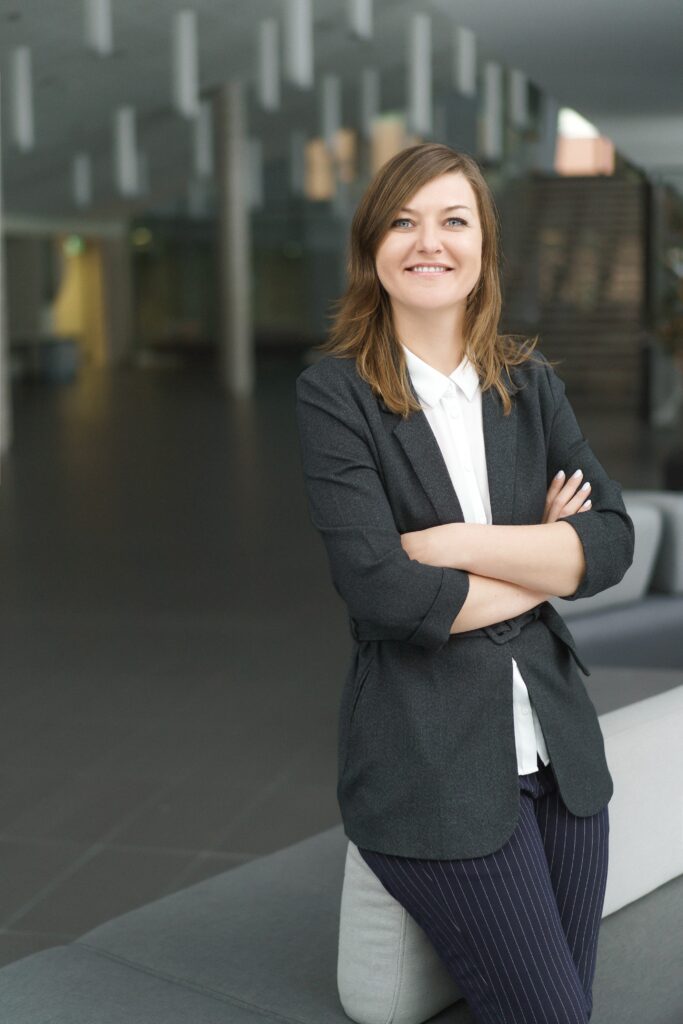
Dovilė Jodenytė, Director of the International Studies Center at VILNIUS TECH, explains that international applicants must navigate a complex selection process.
“The admission process for international students is distinct; they apply nearly a year in advance due to the length of the necessary procedures,” says Jodenytė.
Applicants upload documentation remotely, which is then evaluated by university experts. This includes the formal recognition of foreign qualifications.
“Our experts have extensive experience and collaborate with the Center for Quality Assessment in Higher Education (SKVC) when dealing with applications from more remote regions, such as the Comoros. High school certificates are equated to the Lithuanian maturity diploma, and grades are converted into the Lithuanian system to calculate an entry score,” Jodenytė explains.
Applicants must also submit a recorded interview. This allows the university to assess motivation, experience, and English proficiency, though formal English language certificates are also required. While the highest volume of applications comes from Pakistan, Bangladesh, India, and Nigeria, these candidates do not form the majority of the admitted student body. Currently, VILNIUS TECH hosts a diverse population of students from Ukraine, India, Azerbaijan, Morocco, Belarus, Kazakhstan, Egypt, Sri Lanka, and Turkey.
Students Represent Only 3% of Arrivals
Once an applicant clears these hurdles, they must pay for their first year of tuition upfront. Only then does the university coordinate with the Migration Department to facilitate the student’s legal entry.
“This procedure takes 4–5 months and presents significant challenges. Statistically, international students represent only about 5% of all foreigners arriving to live and work in Lithuania—roughly 4,000 students per year,” Jodenytė reveals.
She notes that the Migration Department works with other institutions, meaning applications can be rejected by the State Security Department (VSD). Furthermore, the Department maintains a “two-strike” rule: if an applicant makes two errors in their application, they are barred from reapplying for four months. “We lose potential students this way. An 18-year-old often lacks experience in navigating complex foreign bureaucracy,” Jodenytė admits.
Cultivating Talent for the Global Market
Prospective students are most attracted to VILNIUS TECH’s programs in IT, Artificial Intelligence, multimedia, computer design, robotics, mechanics, and civil engineering.
Regarding whether these students stay in Lithuania, Jodenytė notes: “While I don’t have exact statistics, I would estimate about half choose to stay, while the other half leave. Our goal is for them to remain, as they are high-qualified specialists with local degrees. Often, they move to other European countries where there are more job opportunities. This may be partly due to Lithuanian companies being hesitant to hire foreign nationals for full-time roles. Collectively, we must work to create a more welcoming environment for them.”