Registration now open for FUTURES in-person classes – online MOOC coming soon

October 6, 2026

Registration has opened for the FUTURES in-person training programme in Lithuania, Spain, Germany, Bulgaria and Sweden. The programme offers young people aged 18–30 who are not currently working or studying around 90 hours of hands-on classes in artificial intelligence, cybersecurity, soft skills and entrepreneurship. In Lithuania, the classes are run by VILNIUS TECH.

An open online course (MOOC) in English covering the same four areas will follow shortly.

What the training covers

The programme pairs two technology areas with the skills employers expect alongside them:

  • Artificial intelligence – how AI and machine learning work, the ethical questions they raise, and hands-on practice with AI tools in everyday and work situations.
  • Cybersecurity – protecting yourself and an organisation online, working with common security tools and reading their results to make recommendations.
  • Soft skills – communication, teamwork, problem-solving and critical thinking, practised through real-world case studies and interactive exercises.
  • Entrepreneurship – the basics of turning an idea into a business, including self-employment as a route into the labour market.

Classes are built around practical tasks, team challenges and game-based activities rather than lectures, and the trainers act as mentors. Each participant starts with an introductory interview so that the trainers can adapt the programme to their situation and goals. During the course, groups from the five countries compete in online challenges – escape-room and capture-the-flag style tasks – and a selected team from each country travels to Albacete, Spain, for a one-week international mobility. Info days and company visits bring participants into direct contact with employers in the AI and cybersecurity sectors. Everyone who completes the programme receives a certificate of completion.

Who can apply and how to register

The in-person classes are open to young people aged 18–30 who are not currently in work, education or training. No previous experience in IT is needed. Places are limited to around 50 per country, so registration is followed by a short selection step and an introductory interview with the local team.

To register, fill in the FUTURES application form.

Online course in English coming soon

For those who cannot join the in-person classes, or who live outside the five partner countries, the programme will also be released as a massive open online course (MOOC) in English. The MOOC brings together the materials of all four areas in at least ten modules and is designed as a lifelong-learning resource that stays online after the project ends. It is open to anyone who wants to build these skills – job seekers, employees updating their knowledge, or students.

VILNIUS TECH developed the Artificial Intelligence module of the course together with Youth Power Germany. The MOOC is hosted on Mälardalen University’s Canvas learning platform, and the link will be announced on the project’s Instagram and on this page as soon as the course goes live.

About the FUTURES project

FUTURES – “Future-proofing disadvantaged youth through tech skills and inclusion” – is an Erasmus+ project. It responds to two trends at once: the number of young Europeans who are neither in employment nor in education or training, and the growing demand for people who can work with AI and cybersecurity. The project aims to bring early leavers from education back into learning and work through hands-on, personalised training, and the consortium expects at least half of those who complete the programme to return to the labour market.

Six organisations from five countries take part: the University of Castilla-La Mancha (Spain, coordinator), Mälardalen University (Sweden), Youth Power Germany e.V. (Germany), VILNIUS TECH (Lithuania), KlemKa CoLAB (Spain) and PNEVMA (Bulgaria). Around 45–50 young people per country – 225–250 in total – will take part in the in-person classes. Alongside the training and the MOOC, the project is producing an educational game in Spanish, Swedish, Lithuanian, Bulgarian and German, and a best-practice guide for youth workers and educators.

VILNIUS TECH in the project

VILNIUS TECH led the development of the joint curriculum agreed by all six partners and, together with Youth Power Germany, prepared the Artificial Intelligence module – from the fundamentals of AI and machine learning to ethics and hands-on use of AI tools in real-life situations. The university also coordinates the training phase across the five countries: the common training schedule, the templates partners use for attendance, evaluation and certificates, and the online cross-country challenges that lead up to the mobility. In Lithuania it runs the in-person classes, the info day and the company visits. In September 2027 VILNIUS TECH will host the project’s final European conference and closing consortium meeting in Vilnius.

More information
Register for the classes in Lithuania: FUTURES application form
Follow the project on Instagram: @futures_youngtech.

Related news

Minister of Foreign Affairs K. Budrys: Lithuania is not an immediate target, but preparedness and resilience remain essential
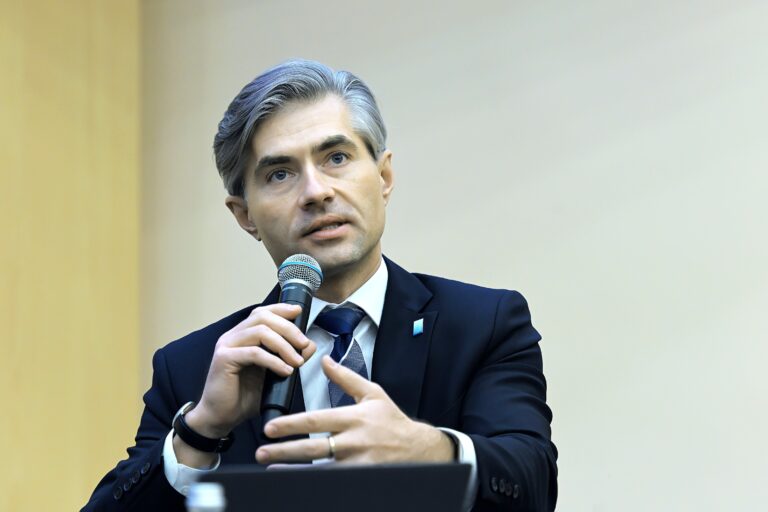
Lithuania’s security situation, the war in Ukraine, relations with the United States and China, and the growing threat of hybrid attacks were among the topics discussed during the public event “Are We Ready for What Comes Next?”, part of the Unlock Lithuania lecture series, featuring Lithuania’s Minister of Foreign Affairs, Kęstutis Budrys. The discussion was moderated by Dr. Vytautas Jankauskas, Adviser on Science and Innovation at the Ministry of Foreign Affairs. [caption id="attachment_136497" align="alignnone" width="2560"] V. Jankauskas and K. Budrys[/caption] Speaking to students and members of the university community, the minister addressed concerns about regional security, explained how Lithuania and its allies are strengthening the country's defence capabilities, and emphasised the importance of public preparedness and reliable information. Lithuania's security depends on preparedness and cooperation with allies Assessing the current security situation in the region, Budrys pointed out that Russia's war against Ukraine has fundamentally changed Europe's security environment. The scale of the conflict, the number of casualties and the use of modern military technologies have created challenges that extend beyond Ukraine's borders. Lithuania also experiences the indirect consequences of the war. Recent incidents involving drones approaching or entering Lithuanian airspace have demonstrated how developments on the battlefield can affect neighbouring countries. According to the minister, such incidents highlight the need to strengthen air surveillance, improve alert systems and ensure that Lithuania can respond quickly to emerging threats. "This is a collective effort. The purpose is to build resilience – the ability to respond quickly and ensure that our society is prepared," he said. Budrys also addressed concerns about the possibility of a direct military threat to Lithuania, emphasising that the current probability of such an attack is low. While Russia's intentions remain a concern, the minister noted that it currently lacks the capabilities to carry out military aggression against Lithuania. "We are not the target at the moment," he said, adding that Lithuania's NATO membership and close cooperation with its allies provide important security guarantees. Public awareness and reliable information are part of national security The minister also addressed the concerns of people who feel unsafe amid growing regional tensions. Drawing on his own experience as a parent, he emphasised that open conversations and clear information can help people better understand potential threats and respond appropriately. He pointed out that preparedness does not mean expecting the worst. Rather, it means knowing what to do in different situations, understanding official instructions and being familiar with available safety measures. For example, people should know where to seek shelter during an alert and how to follow the recommended two-wall safety rule, which means putting at least two walls between themselves and the outside of a building. Budrys encouraged students not to keep their concerns to themselves, but to discuss them with family members, colleagues and university representatives. He also highlighted the importance of critical thinking when following international developments. Noting that many young people get their news from social media platforms such as TikTok, he urged them to question the sources of information and verify what they see online. "Where did you get this information? Where did you read it? How does it work?" he said, describing the questions he regularly asks his own daughter. According to the minister, if the authorities received credible intelligence indicating an imminent threat, the public would be informed immediately. He stressed that transparent communication is essential for building trust and ensuring that people know how to act. Diplomacy remains essential despite growing global tensions The discussion also touched on the future of diplomacy in a world where military conflicts are becoming increasingly frequent. Budrys argued that diplomacy will remain indispensable, as all military conflicts ultimately require political agreements and negotiations to reach a lasting resolution. However, he acknowledged that the international environment is becoming more complicated as the global order shifts from a unipolar to a multipolar system. He warned that fundamental principles of international law, including respect for sovereignty, territorial integrity and the peaceful resolution of conflicts, are increasingly being challenged. Russia's actions in Ukraine, he noted, undermine the international rules established after the Second World War. This is why Lithuania continues to seek international support for Ukraine and advocates for a just and lasting peace. Lithuania seeks a stronger response to Russian hybrid threats In response to questions about Russian sabotage operations, attacks on critical infrastructure and other forms of hybrid warfare, Budrys argued that these activities should be treated as a serious part of Russia's broader military strategy. Lithuania's response, he said, should include increasing the political and economic costs of such operations for Russia. Among the measures he highlighted were further sanctions and efforts to designate Russia's military intelligence service as a terrorist organisation. Budrys emphasised that these threats are not limited to Lithuania or the countries on NATO's eastern flank. All European countries need to assess their vulnerabilities and strengthen their ability to protect critical infrastructure and society. The conversation at VILNIUS TECH gave students an opportunity to raise questions about the issues shaping Europe's security and Lithuania's role in the international community. Throughout the discussion, the minister returned to one central message: security is built not only through military capabilities and international alliances, but also through public awareness, preparedness, resilience and the ability to respond collectively to emerging challenges.
More
Between ships and technology: how can safe vessel traffic be ensured in the port of Klaipėda?
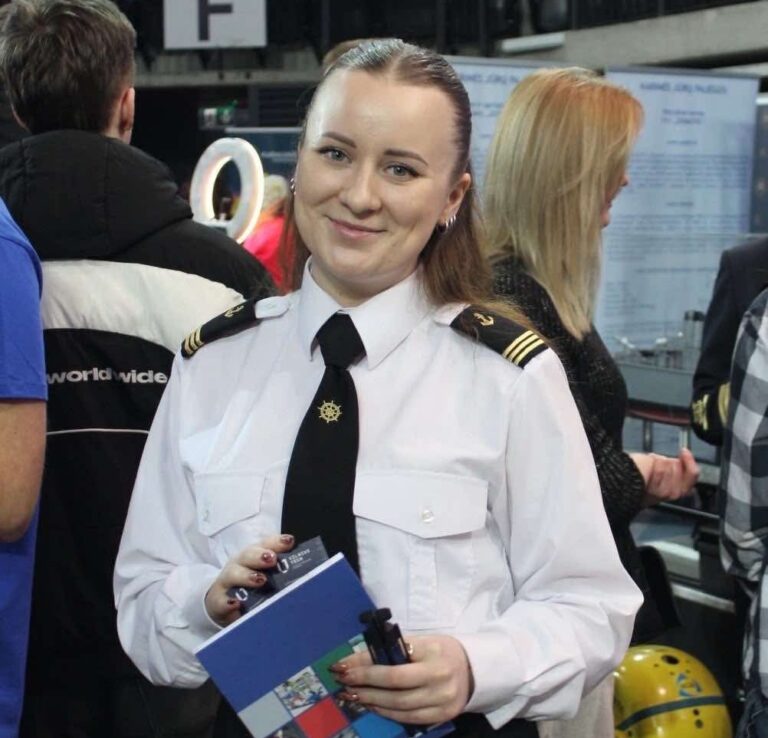
The Port of Klaipėda is Lithuania’s only ice-free port and one of the most important transport hubs in the Eastern Baltic region. Every day, vessels of various types – from passenger and cargo ships to tankers – navigate its waters, making safe vessel traffic one of the port’s key priorities. Heavy maritime traffic, narrower sections of the channel and large vessels moored alongside the quays present challenges for navigation specialists that require not only knowledge and experience, but also advanced technologies. Kamilija Būdvytytė, a graduate of the Marine Navigation study programme, dedicated her bachelor’s thesis to exploring this topic. She was awarded a scholarship by the Klaipėda Industrialists’ Association for research of significance to the city of Klaipėda. In her thesis, „Analysis of the Safe Passing of Vessels with Moored Ships in the Port of Klaipėda Based on the Recommendations and Regulations of International and Local Institutions“, she examined how the speed of a passing vessel and its distance from a moored vessel affect navigational safety. Using an advanced navigation simulator and digital modelling, K. Būdvytytė analysed various vessel-passing scenarios and assessed their impact on mooring systems and overall safety. The research results revealed that even relatively small changes in speed or distance can have a significant effect on the safety of vessel traffic and can help facilitate more effective decisions when organising traffic in the Port of Klaipėda. Although it may seem that the greatest risk is faced by moving vessels, according to the VILNIUS TECH graduate, moored vessels are also exposed to hazards. A passing vessel generates waves, water currents and pressure changes that can affect a moored vessel. These hydrodynamic effects can cause a vessel to be drawn towards the passing ship or pushed away from the quay, placing additional loads on mooring lines and quay fenders. Such situations are particularly sensitive when tankers are moored alongside the quay. „During my research, I paid particular attention to the factors that determine the safe passing of vessels. Some of the most important are vessel speed, the distance between vessels, their size and draught, as well as the width and depth of the channel. Weather conditions are equally important, including wind, currents and visibility. The main principle is simple: the higher the vessel’s speed, the greater the safe distance from a vessel moored alongside the quay should be,“ says K. Būdvytytė. To assess the impact of these factors, she used modern technologies. The research was conducted using the Wärtsilä TRANSAS NTPro 6 navigation simulator, in which the Port of Klaipėda channel was recreated. Different scenarios were modelled to analyse the passing of a Ro-Ro vessel alongside a tanker moored at the quay, while varying the vessel’s speed and the distance between the ships. According to the author, digital modelling provided insights that went far beyond theoretical calculations. The simulator made it possible to assess not only hydrodynamic forces, but also the effects of wind, currents, restricted water depth and changes in manoeuvrability. Such simulations provide an opportunity to safely test a variety of scenarios that would be difficult or even dangerous to reproduce under real-life conditions. „One of the most interesting findings of the research was that even small changes in speed or distance can significantly affect the loads on mooring lines. The highest loads were recorded not when the vessels were approaching or moving away from each other, but when they were sailing parallel to one another in close proximity. For example, when a vessel was travelling at a speed of 8 knots at a distance of just 50 metres from a tanker, the maximum load on a single mooring line reached 7.2 tonnes-force. When the speed was reduced to 4 knots or the distance increased to 120 metres, the loads decreased several times. These results clearly demonstrated that lower speeds and greater distances make a significant contribution to safety,“ explains the VILNIUS TECH graduate. According to K. Būdvytytė, the findings of the research could be useful not only for scientific research but also for the practical operations of the Port of Klaipėda. They could help determine safe sailing speeds more precisely in different areas of the port, improve vessel traffic management procedures, and support the training of pilots and bridge teams. K. Būdvytytė also suggests considering situational speed restrictions in areas where vessels pass particularly close to tankers moored alongside the quays. Today, safe navigation is supported by a wide range of smart technologies. Vessels use electronic navigation systems, radar, Automatic Identification Systems (AIS), electronic charts and various communication solutions. An important role in port operations is played by the Vessel Traffic Service (VTS), which monitors vessel movements in real time and coordinates their actions. „Future ports will increasingly resemble smart transport systems. Artificial intelligence (AI), automated traffic management platforms and so-called digital twins will help predict potential risks more accurately, identify the safest routes and optimise vessel movements. Nevertheless, even as technologies continue to advance rapidly, the human factor will remain crucial – whether it is a pilot, captain or traffic management specialist who makes the final decision in critical situations,“ says K. Būdvytytė. The research conducted by the VILNIUS TECH graduate demonstrates that modern maritime navigation is inseparable from advanced technologies, while safety still depends heavily on people’s ability to make responsible decisions. The study highlights how scientific knowledge, digital modelling and innovation can contribute to safer and more efficient port operations in the future.
More