A city that adapts to water
Climate change is transforming urban planning around the world. Increasingly intense rainfall, more frequent extreme weather events and the growing urban heat island effect are forcing cities to look for new solutions to manage excess water while also creating a higher-quality living environment. With that being said, Gabriela Sokolovskaja, a graduate of the VILNIUS TECH Master's programme in Architecture, suggests looking at this problem from a different perspective: perhaps it is not water that should be adapted to the city, but the city that should be designed according to natural water processes.
She explored this idea in her final thesis, "From utopia to prototype: water as a driver of sustainable urban transformation", in which she analysed how rainwater could be one of the key elements shaping the city of the future rather than being a problem.
"What prompted me to analyse this topic was the increasingly relevant problem of surface water management in the context of climate change. However, I was interested in a broader question - why do we first shape the city and only then decide where water should flow within it? In my work, I tried to reverse this logic: instead of adapting water to the city, to shape the city's structure according to natural water processes. In this way, water became not a technical problem, but a tool for urban transformation," the author explains.
The path from utopia to prototype mentioned in the title reflects an effort to test theoretical ideas in a real urban environment. According to G. Sokolovskaja, urban utopias have often emerged throughout history as responses to various social problems - from sanitation crises to technological changes. Therefore, in this work, utopia became a means of rethinking established urban planning logic, while the prototype made it possible to test these ideas in a specific area.
"Since water itself is a dynamic element that depends on terrain and climate, it became a means of transferring this theoretical idea into urban planning. The prototype is a way of testing it within the real urban fabric of Vilnius. By analysing the terrain and the movement of surface water, it became clear that water behaves very differently in different parts of the city. This led to one of the most important conclusions of the work - there cannot be a single universal model. Therefore, I developed different principles of urban formation for different hydrological and urban situations," says the VILNIUS TECH graduate.
According to her, climate change is transforming beyond urban infrastructure, also affecting the very logic of planning. The city is increasingly understood as more than a fixed structure, but rather a system capable of adapting to constantly changing environmental conditions.
"Intense rainfall, heatwaves and droughts are the factors increasing the importance of green spaces, permeable surfaces, water storage and infiltration. In my work, I wanted to go a step further and ask whether the logic of water could shape not only individual spaces, but the urban structure itself," the author says.
The research also used GIS and terrain analysis tools, which made it possible to model the movement of surface water and identify areas where it accumulates. These analyses helped provide a better understanding of natural processes and became the basis for developing different urban planning principles for different areas of the city.
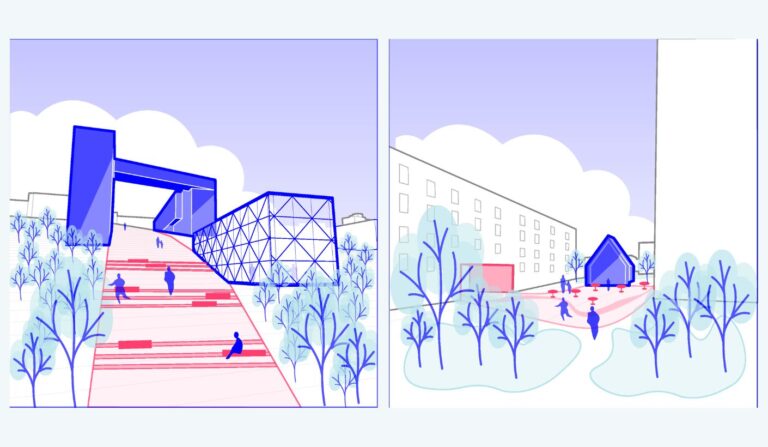
In the imagined fragment of the city, rainwater would not be hidden underground. On the contrary, it would become a visible part of urban spaces and an element of the urban structure. In some areas, water would be collected and infiltrated in sunken green spaces, while elsewhere it would flow through open channels. Such a system would not only help manage excess water generated during heavy rainfall, but would also create new public spaces, recreational areas and pedestrian connections.
"In the detailed fragment, this logic even influences the city's functions: cultural and recreational activities are concentrated around slower, absorbent spaces, while retail, offices and more intensive programmes are located near active channels that carry water away. In this approach, the movement of water organises not only infrastructure but also urban life," G. Sokolovskaja explains.
According to her, the benefits of such a model would extend beyond more effective surface water management. At the same time, green spaces would be created, the microclimate would be improved, pedestrian connections would be strengthened and new public spaces would emerge. "This dual impact is particularly important to me - an investment in climate change adaptation also becomes an investment in the everyday quality of urban life," she says.
The VILNIUS TECH graduate is convinced that in the cities of the future, water should become a more visible and integral part of the urban structure. "If we have to make space for water in the city anyway, I wonder - why could that space not also be a high-quality public area? In that case, infrastructure becomes part of the city's landscape as well as its identity," the author reflects.
In her vision, Vilnius twenty years from now would not be radically different, but rather go through a gradual change. Small absorbent green spaces, water corridors and retention nodes could eventually connect into an integrated system allowing the city to adapt to the challenges of climate change. In this way, the city would grow not against natural processes, but alongside them.
More