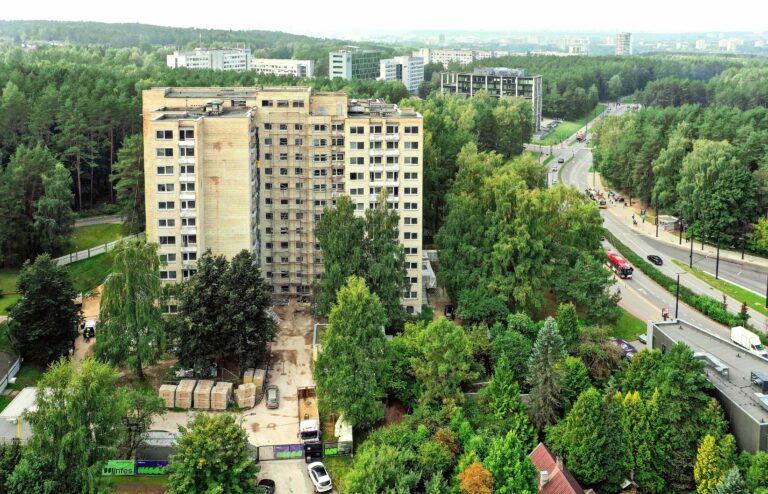
VILNIUS TECH begins renovating one of the largest dormitories in Saulėtekis: around €12.8 million allocated to improve students' living conditions
Vilnius Gediminas Technical University (VILNIUS TECH) has begun its largest and, to date, most expensive student housing renovation project – the renovation of Dormitory No. 5 on Saulėtekis Avenue. Approximately 12.8 million euros will be allocated for the building's repair, modernization, and the improvement of students' living conditions.
Following the implementation of the energetic and functional modernization project for the building located at Saulėtekio al. 19-1, one of the university's largest dormitories will be fundamentally renewed. The exterior will be renovated, the interior premises repaired, spaces redesigned, and the infrastructure modernized and adapted to various needs.
It is planned that, post-renovation, this dormitory will offer arguably the best living conditions out of all VILNIUS TECH dormitories, and the first students will be able to move in by 2028. This will mark the completion of an important stage in the renovation of VILNIUS TECH dormitories in Vilnius, resulting in all of the university's dormitory rooms being repaired and renewed.
According to the Chancellor of VILNIUS TECH, Assoc. Prof. Dr. Vaidotas Trinkūnas, the renovation of the dormitories aims not only to ensure conditions that meet modern hygiene, safety, and quality of life requirements. The university strives to ensure that infrastructure renewal goes hand in hand with student well-being, energy efficiency, building longevity, and accessibility.
"A university dormitory is much more than a place where students stay during their study years. It may never replace home, but we want it to become a place where students safely and comfortably start their independent lives, make friends who often remain for life, learn to live in a community, and leave the university not only with a diploma but also with fond memories of the years spent here," says VILNIUS TECH Chancellor Assoc. Prof. Dr. Vaidotas Trinkūnas.
Major Changes Ahead
With the dormitory's renovation, not only will the exterior be improved—windows replaced and the facade insulated—but the engineering systems will also be updated. A mechanical ventilation and heating system will be installed for all dormitory premises and rooms, achieving higher energy efficiency (Class B). A photovoltaic (solar) power plant is planned for the roof of the renovated dormitory, which will generate part of the electricity required by the building.
The interior premises will be repaired and adapted to students' needs: rest, leisure, and community spaces, individual study and collaborative work zones, and bicycle storage will be created; rooms and common areas will be updated; and kitchenettes and sanitary facilities will be installed in separate blocks.
Following the latest requirements, the entire building's infrastructure will be adapted for students with individual needs—from entrances and elevators to rooms and sanitary facilities.
"For us, renovation is not just about repainting walls or buying new furniture. We aim to create a cozy and functional living environment that provides space for relaxation, independent and group work, socialization, and student events. A student must have the opportunity not only to have quiet time in their room but also to meet with friends, study together, cook meals, or simply be part of the community.
As a university of technology, it is important for VILNIUS TECH that modern solutions are also reflected in the dormitory infrastructure—in efficient ventilation and heating systems, smart lighting and energy consumption management, the use of renewable energy, and other solutions that increase living comfort and reduce the building's environmental impact," states the university Chancellor.
Will Accommodate 500 Students
Unlike previous projects, the exterior and interior renovation of this dormitory is not taking place in stages—all floors of the dormitory are being repaired at once. During the repair, the dormitory is temporarily closed, and its residents are living in alternative accommodations assigned after an individual assessment of each case.
After the renovation, the number of residential places in the dormitory will change, allowing it to accommodate over 500 students. The dormitory will eliminate triple rooms; responding to recent trends and aiming to ensure maximum comfort for students, only single and double rooms will remain.
"We have received a lot of positive feedback from students and their parents about the living conditions in our dormitories. We are glad that students highly appreciate the changes made, as well as the quality-to-price ratio of the dormitories," adds Assoc. Prof. Dr. V. Trinkūnas.
€12.8 Million for Dormitory Renovation
An estimated 12.8 million euros will be allocated for the functional and energy renovation project of Dormitory No. 5. It is financed by the European Union's Recovery and Resilience Facility, the state budget of the Republic of Lithuania, loan funds from ILTE bank, and the university's own funds.
The project's implementation is co-financed by the European Union, with €11,093,079 allocated for the renewal of the residential building—student dormitory No. 5—from the 2021–2027 EU Investment Programme and the state budget of the Republic of Lithuania. The building's renovation is being carried out by the company UAB "Infes".
Every year, VILNIUS TECH invests in infrastructure renewal—improving the study, research, work, and living environments. Currently, 4 out of the 7 university dormitories have been completely renovated, 1 has been repaired, 1 is under renovation, and funding sources are being sought for the renovation of the remaining dormitory.
In the future, there are also plans to renovate the dormitory of the VILNIUS TECH Lithuanian Maritime Academy (LJA) in Klaipėda.
More