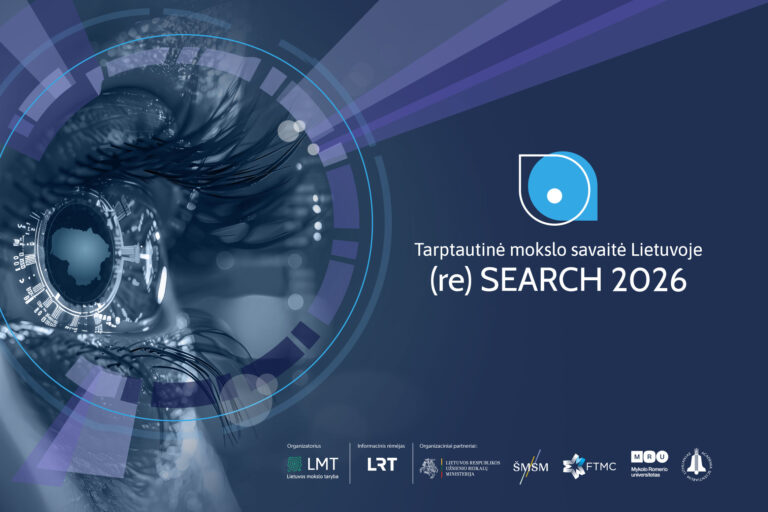
The Research Council of Lithuania (LMT) Invites You to the Science Week "(re)SEARCH 2026"
Over the past few years, technological competition, research security, and science diplomacy have shifted from the academic agenda to the foreign, economic, and security policies of nations. The international science week "(re)SEARCH 2026," taking place in Vilnius on October 19–23, will explore these issues across five different events, bringing together Lithuanian and international scientific, political, diplomatic, and innovation communities.
The context of this year's science week is highly specific. Lithuania is preparing for its Presidency of the Council of the European Union in 2027, while Europe is simultaneously seeking answers on how to maintain scientific openness amidst growing geopolitical tensions, strengthen technological competitiveness, and protect strategically important knowledge and research infrastructures.
The Five Days of "(re)SEARCH 2026":
October 19 – An event dedicated to the 10th anniversary of the Lithuanian-Japanese scientific cooperation program.
October 20 – Lithuanian Science Forum "When Science Builds Bridges".
October 21 – Lithuania-US Science and Innovation Forum.
October 22 – Conference "An Interdisciplinary Approach to Research Security for Managing Geopolitical Risks and Building a Resilient Society".
October 23 – Lecture by Prof. Vytautas Nekrošius titled "The Constitution as a Value".
Detailed information about the "(re)SEARCH 2026" events can be found here.
Themes and Discussions:
"(re)SEARCH 2026" will begin on October 19 with an event dedicated to the 10th anniversary of the Lithuanian-Japanese scientific cooperation program.
This collaboration provides a long-term perspective on international scientific partnerships. Their value is measured not merely by the number of joint projects, but by whether enduring connections between researchers, new shared research topics, and the capacity to sustain collaboration beyond a single funding phase are established over the years.
At the Lithuanian Science Forum on October 20, science diplomacy will be examined as a practical tool of the state—one that helps forge international partnerships, strengthens Lithuania's position in the European Research Area, and grants researchers access to international networks and infrastructures.
The forum will also address Lithuania's role in the evolving European science policy landscape. The upcoming Presidency of the EU Council provides Lithuania with an opportunity not only to administer the European agenda but also to raise issues vital to its own scientific system—ranging from international cooperation to research security and competitiveness.
During the Lithuania-US Science and Innovation Forum on October 21, the focus will shift to how scientific knowledge translates into technology, and how international cooperation lays the groundwork for new technological partnerships and joint innovation projects.
The forum will discuss the ties between Lithuania and the US in biotechnology, lasers, space, and other high-tech sectors. It will also explore the conditions required to harness scientific potential for developing competitive technologies and strengthening the scientific and technological capacities of both nations.
The Lithuania-US Science and Innovation Forum is organized by the Ministry of Foreign Affairs of the Republic of Lithuania, in partnership with the Center for Physical Sciences and Technology (FTMC).
At the international conference on October 22, the focus will be on research security and geopolitical risk management.
Openness, data sharing, and international collaboration are essential conditions for modern science. However, certain knowledge, technologies, or research infrastructures can possess economic and strategic value alongside their academic worth. Consequently, universities, research centers, and state institutions are increasingly faced with the challenge of maintaining open science while responsibly managing the associated risks.
The conference will explore this issue through specific topics: institutional responsibility, the risks of international partnerships, the protection of sensitive data and technologies, and resilience to geopolitical pressure.
The week will conclude on October 23 with a lecture by Prof. Vytautas Nekrošius titled "The Constitution as a Value," which will enrich the "(re)SEARCH 2026" program from the perspective of law, the state, and values.
The international science week "(re)SEARCH 2026" is organized by the Research Council of Lithuania (LMT). Organizing partners: Ministry of Education, Science and Sport of the Republic of Lithuania, Ministry of Foreign Affairs of the Republic of Lithuania, FTMC, Mykolas Romeris University, and the Lithuanian Academy of Sciences.
Media partner: LRT.
More