
- Faculty of Civil Engineering
- Faculty Departments
- Laboratory of Composite Materials
Laboratory of Composite Materials
The Composite Materials Laboratory traces its origins to 1989. The laboratory has operated under its current name since 2017. The laboratory is headed by Dr Valentin Antonovič.
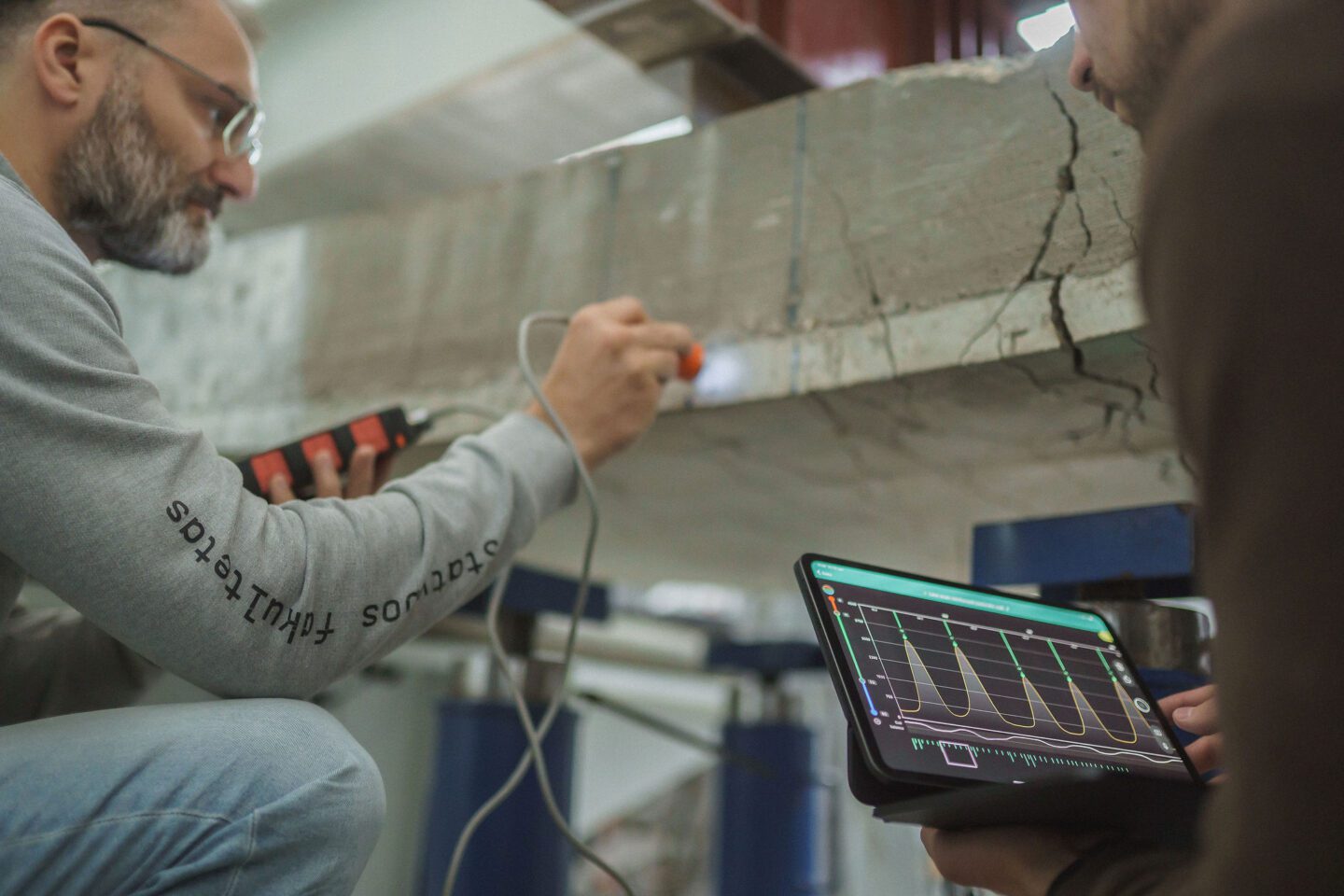
About the Laboratory
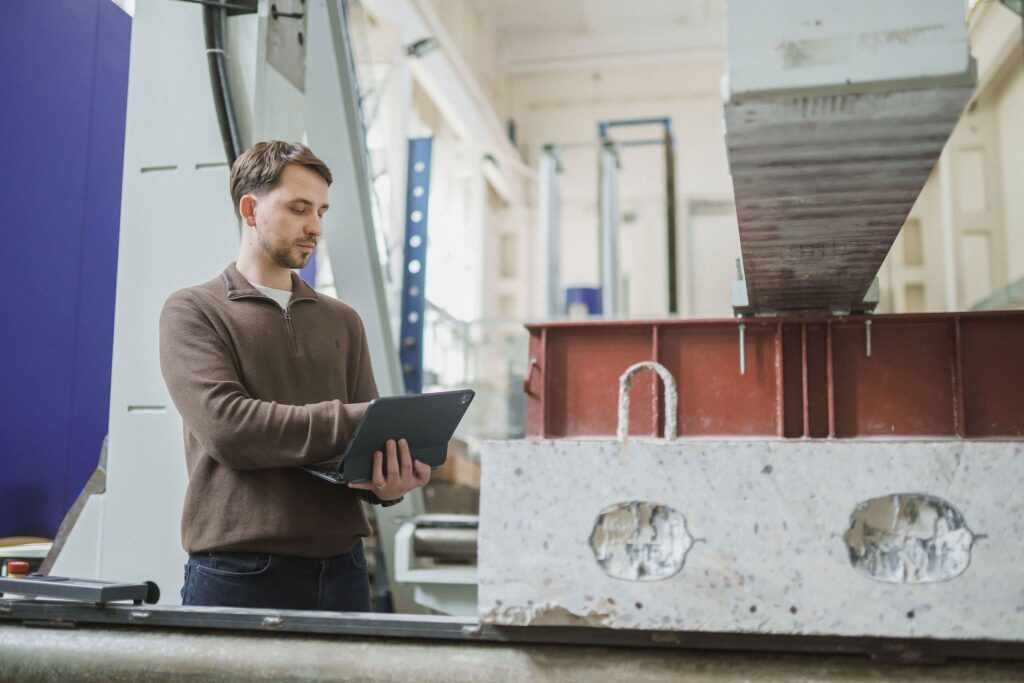
Laboratory Activities
-
Research Areas
The Composite Materials Laboratory carries out research on construction materials, develops innovative composite materials, advances sustainable technologies, collaborates with industry, participates in international projects, and contributes to the study process.- Research on the structure and properties of construction materials (binders, aggregates, as well as cementitious, ceramic, and refractory materials).
- Development of composite materials using chemical and mineral additives and dispersed fibres.
- Use of waste and secondary raw materials (glass, plastics, demolition waste, ash, industrial dust, etc.) for sustainable materials.
- Modification of binder and composite systems to reduce cement content and the CO₂ footprint.
- Evaluation of thermal, mechanical, rheological, and durability properties.
- Application of thermal analysis methods (DTA, TG, DSC) to study phase transformations and material stability.
- Micro- and nanostructure analysis using SEM and other advanced analytical equipment.
- Research on chemical and mineral composition and particle size distribution.
- Measurement of heat released during hydration.
- Use of secondary raw materials and waste in the production of construction materials.
- Expert assessment of the condition of construction structures and materials.
-
Solutions for Industry and Society
The Composite Materials Laboratory develops sustainable solutions for construction materials by improving their durability and integrating secondary raw materials.- Expert evaluation of the condition of concrete, plaster, finishing layers, and thermal equipment linings.
- Development of measures to reduce alkaline corrosion of refractory materials at high temperatures.
- Granulation of fine waste materials and their use in construction material production.
- Structural modification of clay products using chemical additives.
- Solutions for the reuse of different types of waste in construction materials.
- Development of sustainable cementitious materials.
Research Equipment
The Composite Materials Laboratory uses advanced research equipment to analyse the composition, structure, and mechanical properties of materials.
Material Preparation and Processing Equipment
- Raw Material Crushing, Grinding, and Granulation Equipment
- Concrete and Mortar Mixers
- Drying Ovens and High-Temperature Furnaces (up to 1300 °C)
- Grinding and Polishing Equipment
Rheology and Hardening Testing Equipment for Construction Materials
- Rheotest RN 4.1 and SV-10 Vibroviscometer
- ToniCal III Calorimeter
- Ultrasonic and Exothermy Testing Equipment
- Climatic Chamber
Mechanical and Durability Testing Equipment
- Hydraulic Presses (Flexural and Compressive Strength Tests)
- Impulse Excitation Equipment for Determining Elastic Properties
- Alkali Corrosion and Freeze–Thaw Resistance Testing Chambers
Chemical and Structural Analysis Equipment
- Scanning Electron Microscopes (JEOL JSM-7600F, Thermo Scientific Quattro S)
- Linseis STA PT 1600 Thermal Analysis Instrument
- Linseis L76 Dilatometer
- Rigaku ZSX Primus IV X-ray Fluorescence Spectrometer
- X-ray Diffractometer
- Optical Microscopes
Projects
The Composite Materials Laboratory implements national and international projects focused on the development of composite, refractory, and environmentally friendly construction materials and the investigation of their properties. These projects strengthen research and study potential and contribute to the achievement of sustainable development goals.
2025-2028
Research group project funded by the Research Council of Lithuania: “Development of Environmentally Friendly Composites Using Hard-to-Recycle Dust Waste” (DEFCoRD).
Project No S-MIP-25-168.
Project value: EUR 199,965.00.
2024-2028 m.
Digital Europe Programme project: “Housing Decarbonisation Studies in Climate, Health, and Employment” (Skills4Deca).
Project No 01123311.
Value: EUR 5,515,908.85.
2020–2022 m.
European Social Fund co-funded project (based on a grant agreement with the Research Council of Lithuania):
“Micro- and Nanostructure Formation in Refractory Materials with Reduced Cement Content.”
Project No 09.3.3-LMT-K-712-19-0035.
Project value: EUR 129,890.76.
2019–2022 m.
Research Council of Lithuania research group project:
“Structure Formation and Investigation of Composite Materials for Extreme Service Conditions” (KMSFT).
Project No S-MIP-19-41.
Project value: EUR 130,031.00.
2019–2021 m.
Project under the Lithuania–Ukraine Programme for Cooperation in Science and Technology:
“Development and Investigation of Ultra-Light High-Temperature Thermal Insulation Materials Using Production Waste” (ATIM).
Project No S-LU-20-4.
Value: EUR 13,257.20.
2018–2021 m.
European Regional Development Fund co-funded project under the measure “Promotion of the Activities of Competence Centres and Innovation and Technology Transfer Centres”:
Centre for Environmentally Friendly Structural and Composite Materials and Environmental Technologies.
Project No 01.2.2-CPVA-K-703-02-0031.
Project value: EUR 986,523.56.
2013–2014 m.
Project under the Lithuania–Belarus Programme for Cooperation in Science and Technology:
Investigation of Structure Formation in Refractory Materials with Micro- and Nano-Additives for Use in Extreme Conditions.
Project No TAP-LB-12-026.
2008–2010 m.
Lithuanian High Technology Development Programme project:
Nanostructure Formation in Cement-Based Construction Materials: Research and Technological Development (NANO CSM).
Project No AUT-12/2010.
2025–2028 m.
Research group project funded by the Research Council of Lithuania:
Development of Environmentally Friendly Composites Using Hard-to-Recycle Dust Waste (DEFCoRD).
Project No S-MIP-25-168.
Value: EUR 199,965.00.
2025-2028
2024-2028 m.
2020–2022 m.
2019–2022 m.
2019–2021 m.
2018–2021 m.
2013–2014 m.
2008–2010 m.
2025–2028 m.
Partners
The Composite Materials Laboratory works with industry partners in research and experimental development activities.










Show more
Laboratory Staff
The Composite Materials Laboratory team consists of experienced scientists and researchers in materials engineering.
Administration
- Administration
- Research Staff
- Technicians
-
Dr. Valentin AntonovičChief Research Fellow
Show more