
- Faculty of Civil Engineering
- Faculty Departments
- Laboratory of Innovative Building Structures
Laboratory of Innovative Building Structures
About the Laboratory
Research Areas
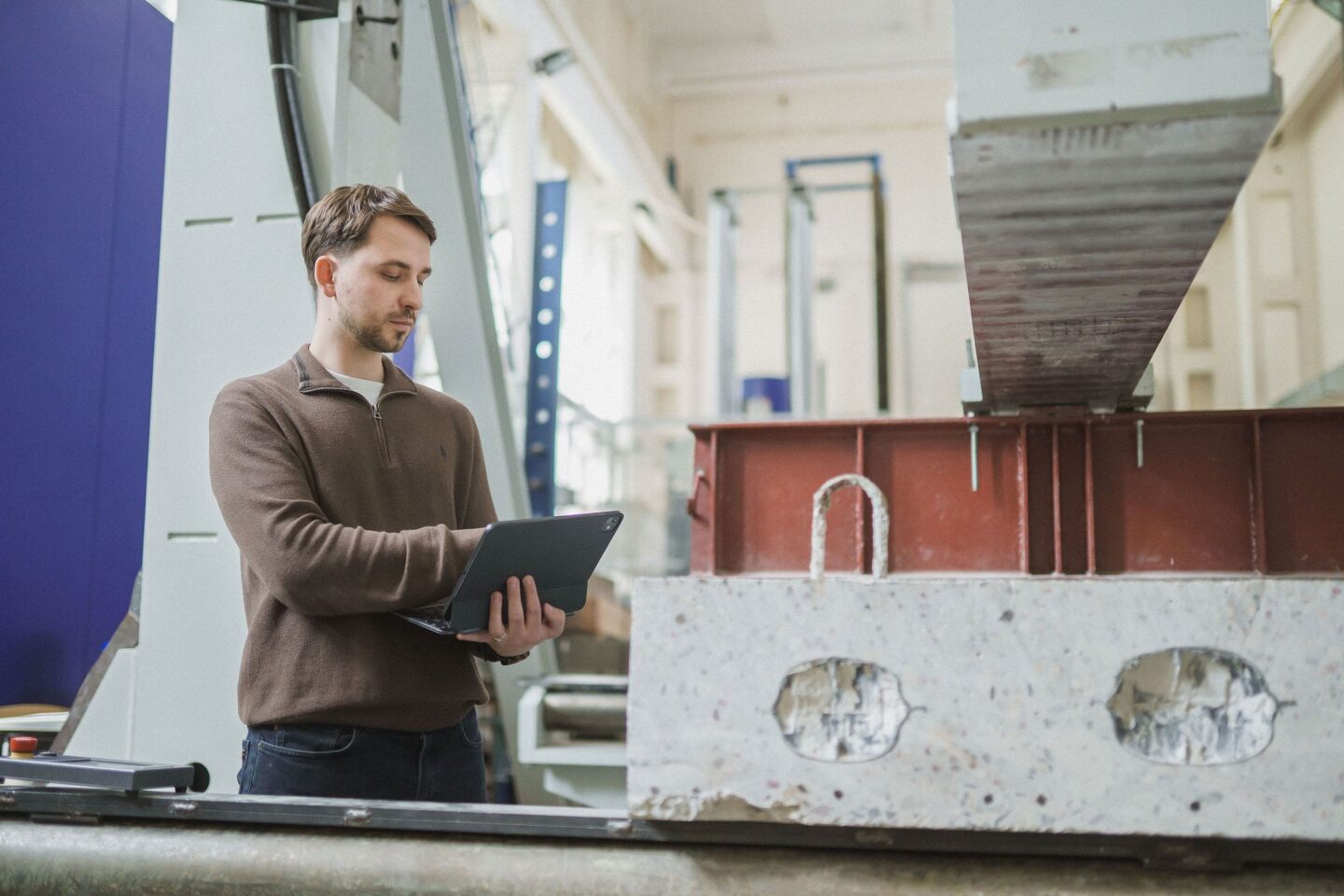
The Laboratory of Innovative Building Structures specialises in advanced research on composite and hybrid structures, including 3D printing, damage modelling, and environmentally optimised design.
Composite and Hybrid Structures
- Composite and Hybrid Structural Systems (Fibre-Reinforced Polymers, Cement-Based Composites, Metal–Polymer Composites)
- Development and Structural Application of Functional Polymer Composites
- Studies on the Performance of Reinforcement Systems
Structural Reliability and Durability
- Structural Damage Modelling and Failure Mechanics of Composite Materials
- Stochastic Modelling of Reinforced Concrete Deterioration
- High-Temperature Effects and Material Durability Research
Digital and Advanced Technologies
- 3D Printing Applications in Composite Structural Engineering
- Advanced Modelling Methods for Assessing Serviceability and Residual Stiffness
Sustainable and Bio-Adaptive Solutions
- Development of Bioactive and Bio-Adaptive Structures
- Environmentally Optimised Design of Structural Components and Systems
Research Equipment
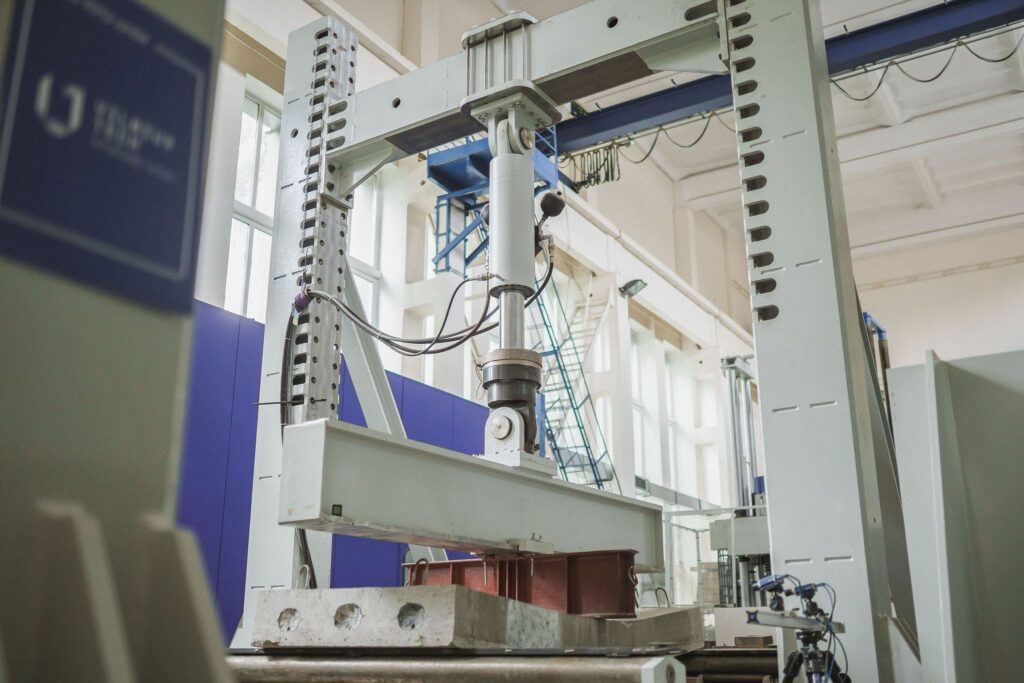
The Laboratory of Innovative Building Structures is equipped with advanced experimental equipment that enables a wide range of mechanical testing, assessment of long-term environmental effects, and prototype production using large-scale 3D printing.
-
Main Equipment
-
LaVision StrainMaster Optical Image Analysis System (Germany) – a digital image correlation (DIC) platform that enables non-contact measurement and visualisation of 2D and 3D deformation fields. It is used for analysing structural behaviour, crack development, and complex deformations.
-
LR-B002-B UV Weather Tester Accelerated Ageing Chamber (China) – used to assess the environmental resistance of polymer materials and composites. It simulates cycles of UV radiation, water vapour condensation, and water spray (rain) in accordance with ISO, ASTM, and other standards.
-
-
Large-Format 3D Printers
-
Modix MAMA-1700 Pellet (Israel) – a pellet-based FGF (fused granulate fabrication) 3D printer designed for large-scale prototyping and production of structural elements. Build volume: 1700 × 1000 × 1000 mm.
-
Modix BIG-120X (Israel) – an FFF (fused filament fabrication) 3D printer with a build volume of 1200 × 600 × 640 mm and the capability to combine two different materials. Suitable for manufacturing architectural models and industrial components.
-
Creality CR-30 (China) – a conveyor belt-based 3D printing system with virtually unlimited length in the Z-axis direction, enabling the production of long or repeating parts.
-
Bambu Lab P1S (China) – a compact and high-speed FFF 3D printer (256 × 256 × 256 mm), suitable for producing functional parts and prototypes using up to four different materials.
-
Prusa MK3.5 (Czech Republic) – a reliable FFF 3D printer (250 × 210 × 210 mm), suitable for precise prototyping and functional part production.
-
-
Other Equipment
-
Instron 9450 Drop Tower Impact Testing System (Italy, under acquisition) – enables dynamic loading tests up to 1800 J impact energy and 24 m/s velocity. Elements can be tested within a temperature range from –70 °C to +150 °C.
-
Zyklos ZZ 75 HE Planetary Mixer (Germany) – designed for the production of fibre-reinforced concrete, refractory mixtures, and heavy industrial mixes. Mixing capacity: approximately 75 L of prepared mixture.
-
Noptel PSM-200 Laser Measurement System (Finland) – used for monitoring structural displacements, vibrations, and deformations. Measurement rate up to 500 measurements per second, with an operating range of up to several hundred metres.
-
Type 8344 Acceleration Measurement System (Denmark) – optimised for measuring low-frequency and low-level vibrations in bridge and composite structure research.
-
Patented Tensile Testing System for Fibre-Reinforced Polymer Bars, Strips, and Composite Elements (Patent No EP 4 098 996 B1) – designed for long-term tensile and pull-out tests. The system enables testing and production of various composite reinforcement configurations, including prestressed elements.
-
Projects
The laboratory has participated in 19 national and international projects, securing more than EUR 1 million in funding.