
- Library
- Scientific Communication
- Scopus AI Tool
Scopus AI Tool

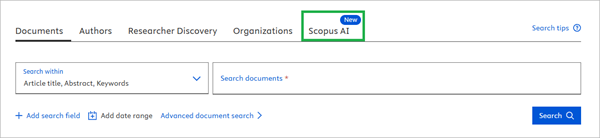
Scopus AI – is Elsevier’s intuitive and intelligent search tool, powered by generative artificial intelligence and content indexed in Scopus DB.
A link to this tool is provided on the Scopus homepage.
Scopus AI uses information (publication abstracts and metadata) from various types of documents indexed in Scopus DB:
- articles;
- books;
- book chapters;
- conference papers;
- reports;
- reviews;
- short-surveys;
- data papers.
The chronological scope of this information varies depending on the selected function, e.g., when generating a response to a query, information from documents published since 2003 is used, but when providing a list of foundational publications or topic experts, information from older publications is also used, regardless of their publication date.
On the initial page of this tool, the user can choose whether their conversation with Scopus AI will be stored in the user’s history (Temporary conversation).
When a user submits a query, Scopus AI generates a concise response in textual form, which includes links to the used sources.

Next to the generated text, an abbreviated list of references is provided, in which the data (publication title, authors, source title, year of publication) are active and redirect to corresponding data in Scopus database.
Show all references link at the bottom of the list provides a complete list of the used sources, which additionally includes publication citation counts and publication abstracts (Show abstract). This list can be exported in various formats.

Additionally, an analogous list of foundational documents of a particular topic, which corresponds to the user’s submitted query, is provided next to the generated text. Show more documents link at the bottom of the list provides complete lists of foundational and other related publications.
A more detailed answer to a query can be acquired by selecting the Expanded summary feature [1].

The Concept map feature [2] generates a diagram that visualizes the links between a topic, which corresponds to the user’s submitted query, and various concepts related to it. This diagram is interactive – when a user clicks on one of the concepts, a text is generated that describes the links between the aforementioned topic and the selected concept.
The Topic experts feature [3] provides information about three experts who are the leading researchers in a field, which corresponds to the user’s submitted query. The information is provided in a list, which includes summaries of each expert’s qualifications in the research field, relevant publication and their citation counts, as well as h-index values. More information about an expert can be acquired by clicking the Preview profile link.
The feature Emerging themes [4] provides a list of topics related to the user’s query, compiled based on abstracts of publications published in the last 24 months. These topics are divided into 3 types:
- Consistent themes – research areas with publication rate, which remained stable for the past 2 years.
- Rising themes – research areas with noticeable increase in academic activity.
- Novel themes – developing research areas with recent interest.
For each theme a brief description, a link to theme’s reference list, and a few potential hypotheses (they are active and act like queries submitted by the user in the initial Scopus AI page) are provided in the list.
Scopus AI also provides suggestions for new queries, which are thematically related to the user’s original query (Go deeper) [5].
In 2025, Scopus AI was updated with a new Deep Research feature. When this feature is turned on (this can be done in the initial page of Scopus AI), the answer to the user’s query is given in a form of detailed report, consisting of overview of the main findings, suggested research areas and methods, references to relevant publications, and other information. These reports can be downloaded in PDF format.
