
A visit to MIT opened up new avenues for collaboration, ranging from autonomous systems to urban co-creation

October 16, 2026

A week-long visit by the Lithuanian consortium to the Massachusetts Institute of Technology (MIT) provided VILNIUS TECH with the opportunity to advance joint research projects, establish connections for future research grant proposals, and explore best practices that could be applied across the university’s activities.

During the visit, Assoc. Prof. Dr. Artūras Medeišis, Dean of the Faculty of Electronics (EF) and Head of the ComARC centre, alongside Vilma Purienė, Director of the Knowledge and Technology Transfer Centre (KTTC / ŽTPC), took part in meetings with MIT researchers and innovation experts, attended presentations of Lithuanian living labs, and participated in “MIT Future Fest.” The insights gained relate directly to ComARC’s activities, student education, technology commercialisation, and the creative potential of “LinkMenų fabrikas.”

Taking place from September 29 to October 6, the visit offered a comprehensive look into the MIT innovation ecosystem across various interconnected processes: scientific research, prototyping, user engagement, licensing, and business partnerships. The VILNIUS TECH representatives also presented Lithuania’s competencies and potential avenues for practical collaboration.

Tangible collaboration opportunities for autonomous systems research

Assoc. Prof. Dr. A. Medeišis visited MIT Lincoln Laboratory, where he met with the lead researcher to discuss the progress of ongoing projects, next steps, and future plans related to dual-use technologies and resilience. The face-to-face meeting proved invaluable for coordinating project continuity and clarifying key aspects of future joint work.

Assoc. Prof. Dr. A. Medeišis and V. Purienė also visited MIT’s Mission Innovation X (MIx), where they explored the development of dual-use innovations with Keenan Blatt. The showcased approach is highly relevant to “ComARC”—the VILNIUS TECH Competence Centre for Autonomous, Remotely Controlled, and Connected Systems.

At MIx, research and student learning are directly tied to real-world operational challenges faced by organizations. Teams build prototypes, identify user needs, and develop plans for further scaling. The presented “MIT Dual-Use Readiness Levels” framework helps evaluate technological maturity in tandem with readiness to engage both civilian and defense sector clients and funders.

“The meeting with the Lincoln Laboratory researchers helped us advance our existing projects and map out future directions. The experience at Mission Innovation X complemented these discussions with a practical perspective: how to align research with user needs, testing, and continuous technology development. Within ComARC, we see clear opportunities to adapt elements of this approach—such as joint tasks for students and researchers, the systematic validation of solutions with partners, and a more comprehensive assessment of project readiness,” said the Dean of EF.

During the MIT-Lithuania event held on October 5, promising contacts were established for prospective “Global Seed Grants” applications. Discussions focused on energy and other research areas laid the groundwork for future dialogue involving the VILNIUS TECH Faculties of Mechanics and Electronics. The immediate next step is to work with researchers to select tasks of mutual interest and evaluate the potential for joint grant proposals.

Technology transfer: a collaborative path from research to market

A meeting with Deirdre Zammit, a representative of the MIT Technology Licensing Office, provided practical insights into the evaluation, protection, and licensing of inventions. Particular emphasis was placed on early engagement with researchers, assessing technology application potential, and understanding market demand.

The visit highlighted a clear division of responsibilities: the work of licensing professionals is complemented by specialized units driving business development, investor relations, and team building. The Industrial Liaison Program, presented by Ron Spangler, demonstrated how enduring connections are built between enterprises and university researchers, while a discussion with Rana K. Gupta, Executive Director of the Deshpande Center, added a valuable perspective on launching tech startups and navigating the market.

At VILNIUS TECH, these interconnected functions are concentrated within the Knowledge and Technology Transfer Centre (KTTC). The MIT experience underscored the vital importance of a university-wide “one-stop-shop” model: KTTC serving as the primary point of contact for both researchers and business partners, guiding the process from an initial need or concept to the right specialists, joint projects, and the application of results. Achieving this requires streamlined communication, clear responsibilities, and consistent engagement across faculties and departments. Such a framework would allow KTTC to carry out its mission more effectively, ensure continuous support, and strategically expand the university’s partnerships.

“I measure the true value of this visit by the work we can advance upon our return. We established contacts for joint research, explored technology transfer practices, and saw how student creativity can be channeled into solving real-world challenges. VILNIUS TECH possesses strong competencies to offer to partners. Sustained collaboration with MIT will help us develop these capabilities further and apply the insights gained to the activities of KTTC, our faculties, and ‘LinkMenų fabrikas,'” noted KTTC Director V. Purienė.

“MIT Future Fest” offered an inspiring opportunity to hear world-class innovators share the stage and witness the intersection of science, technology, design, and art. The vibrant, student-driven atmosphere of the MET Warehouse was reminiscent of “LinkMenų fabrikas,” prompting ideas on how to enhance project presentations and ensure their continuity beyond hackathons and accelerator programs.

Particularly memorable was the “Amphibian Drift” experience at MIT.nano, created by Nomeda and Gediminas Urbonas alongside Markus J. Buehler. In this installation, a scientific molecular model is transformed into an explorable environment of visuals, sound, and motion. This approach aligns closely with the VR, AR, and digital media capabilities of “LinkMenų fabrikas.” Paired with the interactive nature of the MIT Museum, it sparked ideas for a pilot VILNIUS TECH science exhibition to be developed in collaboration with researchers from a selected field.

A panel featuring Hugh Herr, Ana Rajčević, and Paola Antonelli highlighted the intersection of biomechanics and design in creating human-assistive technologies—insights that will be shared with colleagues in biomechanics at the university. Meanwhile, the “Artificial Intimacy” conversation with Sherry Turkle and Rosalind Picard expanded the visit with crucial perspectives on the impact of AI on human relationships, providing a meaningful lens through which to evaluate solutions developed by students.

Communities as partners in living laboratories

Vilma Purienė’s discussion with Sonya Atalay, MIT Professor of Anthropology and Director/Principal Investigator of the Center for Braiding Indigenous Knowledges and Science (CBIKS), brought a valuable community-engagement dimension to the visit. The researcher specializes in community-based participatory research, research ethics, and weaving Indigenous and local knowledges with Western science.

These insights are directly applicable to VILNIUS TECH’s collaboration with “ID Vilnius.” Engaging citizens’ lived experiences right from the problem-definition stage enables a deeper understanding of real needs, usage contexts, and the social acceptance of future solutions. A promising next step could be selecting a concrete urban challenge that university researchers and students would tackle alongside “ID Vilnius” and the local community—from identifying the problem to testing prototypes and evaluating outcomes.

Discussions on micro-credentials were held with Susana Kevorkova, Program Manager for the MIT Institute for Data, Systems, and Society (IDSS) MicroMasters Program in Statistics and Data Science. Drawing on her extensive background in developing and delivering digital learning programs, the exchange offered practical perspectives on how VILNIUS TECH’s expertise could be adapted into flexible learning pathways tailored to the specific needs of industry professionals and businesses.

The value of sustained partnership lies in joint work

Continued collaboration with MIT would enable VILNIUS TECH to expand joint research initiatives while strengthening international talent cultivation and recruitment. The connections established on October 5 provide a strong foundation to assess MIT Global Seed Funds opportunities and develop collaborative project concepts together with researchers from the Faculties of Mechanics and Electronics.

Alongside these efforts, it would be valuable to explore possibilities for research internships, practical placements, and student involvement in joint research assignments. Such an ongoing partnership would help VILNIUS TECH students hone their skills in an international environment, while simultaneously opening doors for MIT students and early-career researchers to contribute to projects based in Lithuania. Ultimately, the continuity of this visit will be reflected in aligned research priorities, joint grant proposals, agreed internship opportunities, and collaborative technological solutions.
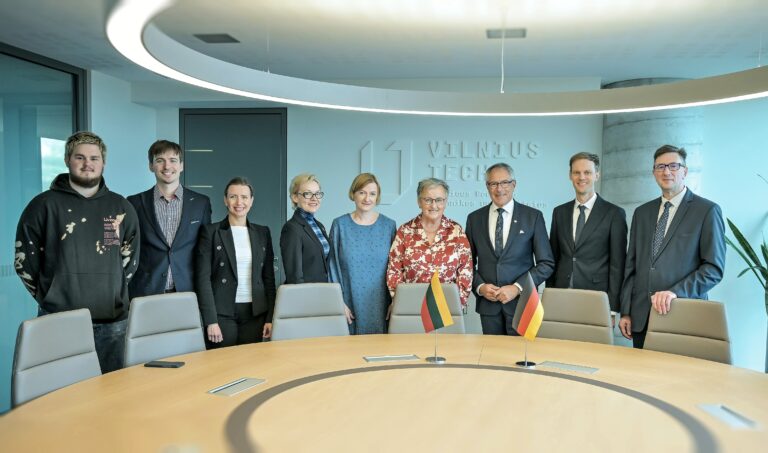
 

Photo gallery – here.

Related news

Rector of Esslingen University Visits VILNIUS TECH: Focus on International Cooperation and Transport Engineering Innovations
The Rector of Esslingen University of Applied Sciences (Hochschule Esslingen, Germany), Prof. Dr. Christof Wolfmaier, visited VILNIUS TECH. During the visit, discussions focused on prospects for cooperation between the two universities, opportunities for academic mobility of students and teaching staff, and the research and educational infrastructure of VILNIUS TECH and its Faculty of Transport Engineering. The guest also learned about ongoing research activities and engineering projects developed by students. International Partnership – New Opportunities for Education and Research During the meeting, Assoc. Prof. Dr. Adas Meškėnas, Vice-Rector for Strategic Partnerships at VILNIUS TECH, emphasised the importance of international cooperation in strengthening the university's academic and research potential. "International partnerships are one of the key priorities of our university's strategic development. Cooperation with foreign higher education institutions creates new opportunities for students, teaching staff and researchers, while promoting the exchange of knowledge and best practices. We are pleased to see our ties with Esslingen University growing stronger and hope that the joint activities already implemented will provide a solid foundation for new initiatives in education, research and innovation," said Assoc. Prof. Dr. Adas Meškėnas, Vice-Rector for Strategic Partnerships at VILNIUS TECH. Cooperation Based on Academic Mobility and Knowledge Exchange The VILNIUS TECH Faculty of Transport Engineering and Esslingen University have already established active academic cooperation. Through an exchange programme supported by the German Academic Exchange Service (Deutscher Akademischer Austauschdienst – DAAD), students from the Faculty of Transport Engineering have visited Esslingen University of Applied Sciences on three occasions. These visits provided opportunities to become familiar with the study process, teaching and research infrastructure, and approaches to practical engineering education. Cooperation between the universities has also been strengthened through visits by academic staff, during which participants exchanged academic experience and discussed matters related to study organisation, teaching methods and research activities. The visit of the Rector of Esslingen University to VILNIUS TECH provided another opportunity to review the outcomes of previous joint activities and discuss future directions for developing the partnership. Focus on Transport Engineering Research and Laboratories During his visit to the VILNIUS TECH Faculty of Transport Engineering, Prof. Dr. Christof Wolfmaier, Rector of Esslingen University, whose academic background is in the field of transport engineering, toured the transport engineering and logistics laboratories. He became acquainted with the equipment used in these facilities, ongoing research activities and opportunities for practical student training. The guest showed particular interest in the faculty's research projects in the fields of autonomous transport and railway transport. These areas are highly relevant to the transport sectors of both Lithuania and Germany, where automation, digitalisation, safety and sustainable technological solutions are becoming increasingly important. Discussions also addressed current trends in transport engineering, opportunities for applying research results in practice, and the role of universities in preparing specialists for the rapidly evolving transport sector. From Scientific Research to Student-Designed Vehicles Another particularly engaging part of the visit was dedicated to practical engineering projects developed by students. The guest examined the faculty's conventional and electric go-karts, learned about their technical solutions and explored other innovative ideas being implemented by students. However, the visit went beyond simply observing the exhibits. Prof. Dr. Christof Wolfmaier personally tested a pneumatic go-kart designed and built by students, which is powered by compressed air. This unconventional engineering solution enables students to apply their knowledge of computer-aided engineering, mechanics, pneumatics, vehicle design and control systems in practice. The guest also had the opportunity to take a ride in a student-built electric vehicle and experience the results of their practical engineering work firsthand. Such projects demonstrate that transport engineering studies extend far beyond theoretical knowledge. Students have opportunities to design, build, experiment, test their solutions and improve them under real-world conditions. New Opportunities for International Partnership According to Prof. Dr. Olegas Prentkovskis, Dean of the VILNIUS TECH Faculty of Transport Engineering, visits of this kind are important not only for maintaining institutional relationships but also for creating new opportunities for cooperation. "We are pleased that our cooperation with Esslingen University has already produced tangible results, including student academic exchanges, visits by teaching staff and the establishment of professional connections. It is particularly important to us that international partnerships provide students with opportunities to gain new experience, learn about engineering solutions developed in other countries and broaden their professional horizons. We are also delighted that our guest showed interest in the research conducted at our faculty and had the opportunity to experience the vehicles developed by our students not only in theory but also in practice," said the Dean of the Faculty. The visit highlighted the shared interest of both universities in expanding international academic mobility, promoting cooperation among teaching staff and researchers, and exploring opportunities for joint educational and research initiatives. The visit of the Rector of Esslingen University once again confirmed that international cooperation, scientific research and students' practical engineering activities are among the key strengths of a modern university of technology.     Foto: Alekso Jauniaus
More
Video Learning Resources Available at VILNIUS TECH: JoVE, OnArchitecture and Visible Body Suite
Members of the VILNIUS TECH community have access to three databases offering video content and interactive learning resources: JoVE, OnArchitecture and Visible Body Suite. These resources combine visual content and interactive tools to help users understand complex concepts and explore scientific methods, practical procedures and design solutions. Each platform serves a distinct purpose, enabling students, lecturers and researchers to find resources relevant to their academic and professional interests. JoVE – Scientific Research and Experiments in Video Format JoVE (Journal of Visualized Experiments) is a scientific video platform that supports learning, teaching and research. It offers thousands of videos demonstrating laboratory experiments, research methodologies and scientific procedures. Its content spans a broad range of disciplines, including the life sciences, physics, medicine, psychology, engineering, statistics and environmental science. Accompanying text and scientific article content provide additional context and help users explore topics in greater depth. JoVE is particularly useful for students seeking to connect theoretical knowledge with practical applications, lecturers looking to enrich their teaching with visual materials, and researchers exploring experimental methods and research techniques. OnArchitecture – Contemporary Architecture and Design OnArchitecture is a video library dedicated to contemporary architecture, featuring leading architects, their ideas and their completed projects. The collection includes video interviews with architects from around the world, offering insights into their creative processes, professional experience, design philosophies and built works. Users can also explore presentations of architectural projects, project descriptions and technical specifications. The platform is a valuable resource for architecture and design students, lecturers and professionals seeking inspiration, analysing design approaches or gaining a deeper understanding of contemporary architectural practice and trends. Visible Body Suite – Human Anatomy in an Interactive 3D Environment Visible Body Suite is an interactive learning platform featuring three-dimensional resources for studying human anatomy, physiology and the health sciences. Users can explore the structure of the human body, examine individual organs and organ systems, and investigate the relationships between them through detailed 3D anatomical models and other visual learning materials. This interactive approach helps users understand spatial relationships within the body and gain a clearer insight into the structure and functioning of complex biological systems. Visible Body Suite supports the study of anatomy and physiology, preparation for lectures and practical classes, and independent learning in the health sciences. Access: the content of all databases can be accessed from a personal computer connected to the VILNIUS TECH computer network via VPN. When connecting to the VPN service, two-factor authentication.
More