Not every success story begins with a clear vision or a straight path to the top of one’s career. Sometimes it emerges from exploration, experimentation, and unexpected decisions that eventually form a solid professional foundation. Darius Snieška’s story is exactly that: from tentative first steps and hands-on work to international experience and leading one of the most important companies in the transport sector, “Scania Lietuva”.
Snieška’s experience reveals how consistent work, curiosity, and the ability to embrace challenges can open doors to an extremely dynamic and constantly changing sector.
An unexpected entry into the world of transportation
The decision to pursue a degree in transportation engineering was unexpected — having graduated from high school with average grades, D. Snieška did not attempt to enroll in university at the time and was choosing between working and attending a community college. He ultimately chose the latter, where he began studying engineering, and after graduating, he got a job at a car repair shop.
However, after six months, he realized that this job wasn’t for him and that he wanted to continue developing his skills, so he enrolled at Vilnius Gediminas Technical University (VILNIUS TECH) and chose the part-time program in transportation engineering (then known as “Automobiles and Automotive Industry”) at the Faculty of Transportation Engineering.
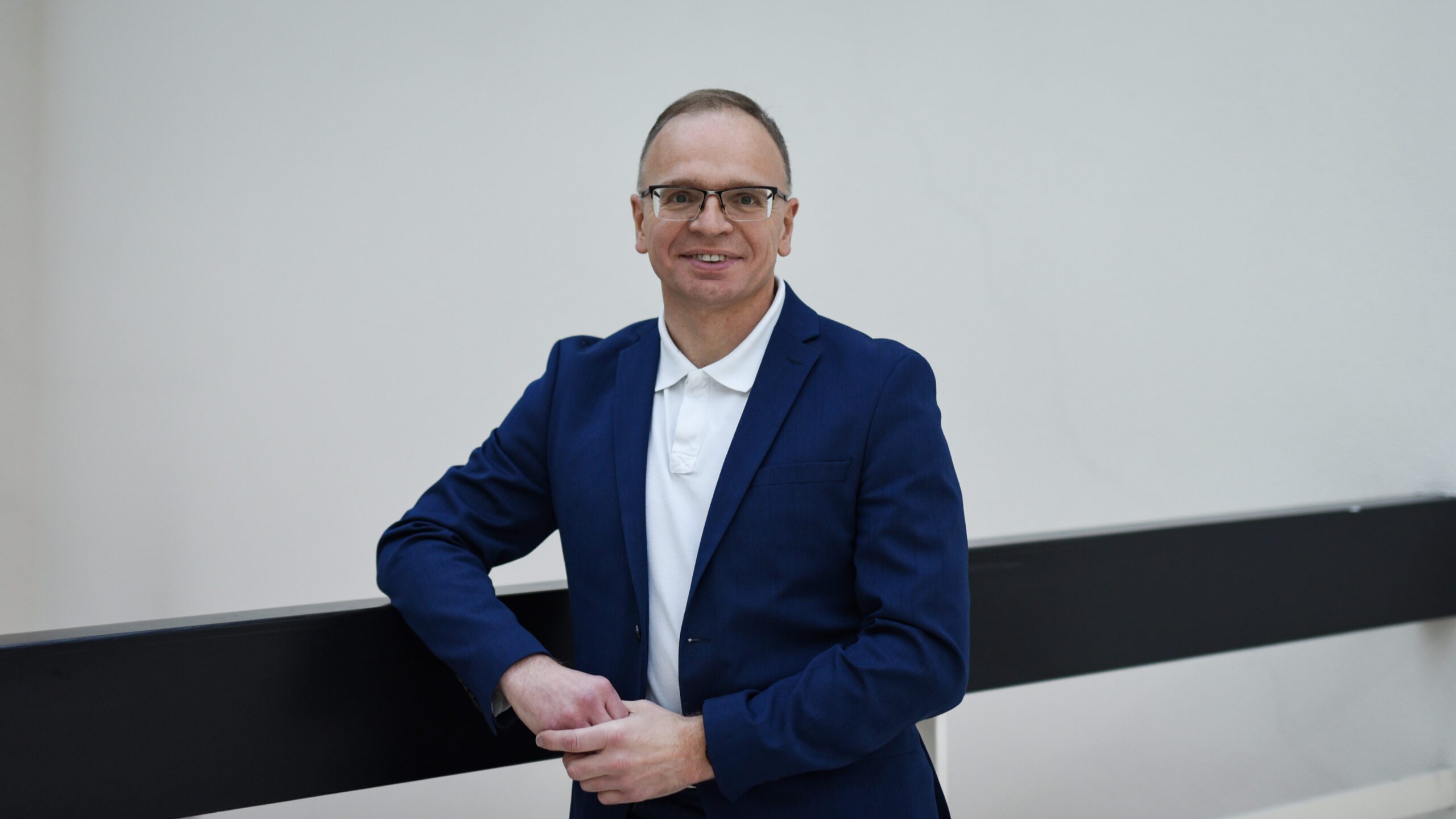
Darius Snieška
“It was a continuation of exactly what I had already been studying. I wanted to earn a bachelor’s degree and delve deeper into this field. By that time, I had already started working, so it was only natural that I had the confidence to study at a university, and as the future would later show – to do it successfully. I certainly haven’t regretted that decision.”
From a simple salesperson to a top executive
According to him, the knowledge and experience gained during his studies came in handy later on, when he was already working as a car sales manager: at university, he became familiar with transportation, its ecosystem, cars and their structure, and logistics. “When I started working, I realized that my engineering knowledge helped me properly configure and sell them. That really requires a solid understanding of technical matters.”
Admittedly, when he applied to “Scania Lietuva” after seeing a job ad in the newspaper, his knowledge of heavy-duty vehicles was limited to the technical side. Nevertheless, this didn’t prevent me from starting my career at the representative office of the largest provider of such vehicle solutions and services, which had just established itself in Lithuania.
“Over the course of eight years working in Lithuania, management saw that I was very successful at selling products, so they offered me a transfer to Sweden. There I was responsible for developing the Eastern European markets and vehicle sales. After two years, I was transferred to Russia, with which Scania was still collaborating at the time (it withdrew in 2022) and where the company was expanding its business. There, we had two extremely risky but, at the time, the most successful projects in the company’s history.”
The first project was a unique opportunity to become the largest transporter of athletes and spectators during the Sochi Winter Olympics. This required 800 buses, making it the largest deal in Scania’s history at the time. “It was a very high-risk project that we worked on for five years. For me personally, it became a challenge because I had to find decision-makers in a foreign country, coordinate various matters with many institutions, and ultimately not give up and keep moving forward.”
The second opportunity was similar, but this time involved participating in the World Cup, which drew more than 10 million viewers that year. “Projects like this come along once in a lifetime. At first, we didn’t really expect it, but the team made it all happen. It took a lot of crazy work every day to make it happen,” recalls the VILNIUS TECH alumnus.
When his contract ended, D. Snieška was offered an even more impressive position — to become the head of Scania’s representative office in Lithuania, a role he has now held for eight years. According to him, it was precisely those earlier decisions to leave that were the most difficult, but also the most successful. “This helped prove both to myself and to others that it is possible to achieve good results and pursue a career in other countries, and that ultimately led to this position.”
What does it take to be a good specialist in the transportation sector?
D. Snieška explains that in such a position, it is important to understand all levels of the company and to experience them firsthand. It’s also very important to understand the commercial side, car sales, and financial aspects. “In practice, you have to work your way through every position starting from the very bottom to truly understand it all. You can’t skip a single step if you want to later understand what the team is talking about – after all, a manager’s primary job is to work with both employees and customers.”
He continues: “The key aspect of a manager’s role today is leadership. Since the work involves processes carried out by other people, a manager must know how to guide the team forward.
Another extremely important aspect of working in such an organization is a strong engineering background: “It’s essential to understand what a car consists of and its components, not only from a practical but also a theoretical perspective. From experience, I can say: at our company, we see that engineers get up to speed much faster and achieve results more quickly than those who lack this knowledge. We have quite a few people working here who studied specifically at the Faculty of Transport Engineering at VILNIUS TECH, and they usually manage to grasp everything much faster than employees who graduated from other fields.”
Speaking about the nature of the work, D. Snieška explains that throughout the year, “Scania Lithuania” hasn’t had a single workday that was exactly the same as the one before. There’s little routine in such a role — you often have to attend meetings, go on business trips, and perform a wide variety of other tasks. “I would find it difficult to do repetitive work, so this kind of dynamic really ‘gets me going.’ That’s probably what has kept me at this company for so many years. This kind of work, just like the transport market itself, is for people who don’t like stability.”
The endless opportunities of the transportation sector
Having achieved an impressive career, D. Snieška advises those still considering a degree in transportation engineering not to hesitate — there will always be work, and the demand for specialists is growing every day: “There’s a reason for the saying that the transportation sector is the engine and wheels of the economy. It drives the world forward in the truest sense of the word. The need for such specialists will never disappear, and no artificial intelligence will replace them. Moreover, since this sector is constantly growing and changing, it constantly needs specialists in new fields.”
D. Snieška has plenty of advice for future transportation engineers:
“First of all, after finishing your studies, don’t be afraid of practical work — it’s better than waiting for the perfect offer. Having that on your resume looks much better to an employer than having nothing at all. Even if you don’t stay in that job for long, you’ll still gain invaluable experience.”
The second piece of advice is to never stop learning and improving. According to him, graduating doesn’t mean you can stop, because knowledge quickly becomes outdated and the market is constantly changing, so you must stay informed about what’s happening and what innovations are emerging. “If you don’t keep pace with changes in the sector, it will be very difficult to adapt to the market, and employers definitely notice that. In this case, it’s also helpful to listen to what other specialists in the field have to say and not be afraid to ask them questions. Don’t forget that thinking you know everything limits your growth.”
For more information about VILNIUS TECH’s Transport Engineering program visit: https://vilniustech.lt/en/faculty-of-transport-engineering/