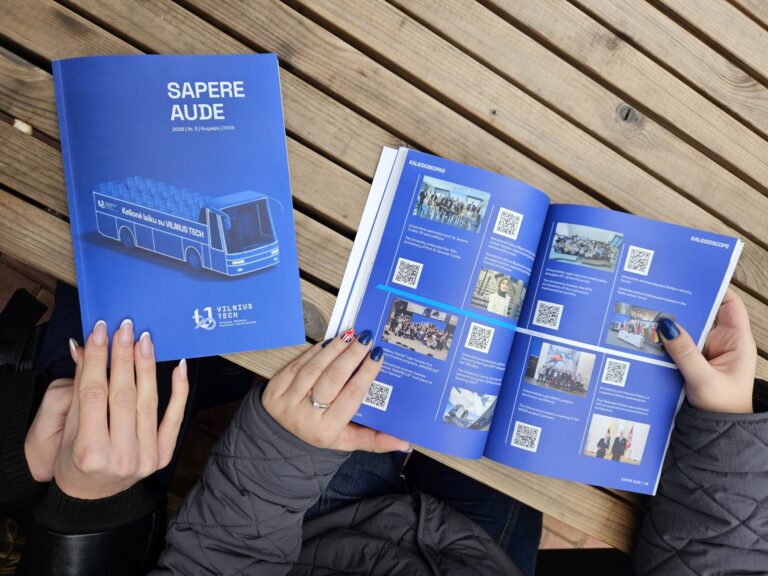
The VILNIUS TECH Library offers a wide range of information resources to support study and research. Its extensive collection of print and electronic resources is tailored to the needs of different fields of study and research. These resources enable members of the VILNIUS TECH community to access the latest scholarly information quickly and conveniently, both on campus and remotely. The Library continuously expands its collections to ensure access to reliable, high-quality, and up-to-date information for study, research, and professional development.
The Library’s print collection includes textbooks, scholarly monographs, dictionaries, encyclopaedias, periodicals, and other information resources. These materials support users in deepening their knowledge, preparing for lectures, and completing academic and research assignments.
Even more opportunities are available through the Library’s electronic resources, including e-books, journals, research evaluation and statistical data, video resources, and more.
The Library’s Subject Information section provides a curated selection of electronic resources organised by academic field and subject area, making it easier to find relevant information for specific study and research needs.
The Trial Databases section provides information about electronic resources that are not currently subscribed to by VILNIUS TECH but are temporarily made available by publishers for evaluation. This section is regularly updated to reflect the databases and resources currently available for trial access.
All Library resources can be searched through a single access point — the VILNIUS TECH Virtual Library. It enables users to search across the Library’s collections, the LST Standards Catalogue, subscribed databases, and open-access electronic resources.
The Virtual Library can be accessed from any computer with an internet connection. Users accessing resources from outside the VILNIUS TECH network must use the VPN service to access the full text of electronic publications. For secure VPN access, two-factor authentication is also required. Users can verify their connection through a mobile authentication application or by phone call.
VILNIUS TECH subscribed multidisciplinary and specialised databases:
 |
Academic Complete & Library Thing Books Cover Widget Package a database containing more than 240,000 electronic books covering various fields of science. |
 |
Access Engineering (McGraw Hill) – a technology and engineering sciences database containing more than 900 interactive graphics, tables, calculators, case studies, and other visual materials. |
 |
ACM Digital Library – open-access journals, conference proceedings, and other publications on computer science and information technology. |
 |
ACS Publications – more than 60 scientific journals covering chemistry and related fields. |
 |
Applied Science and Technology Source (per EBSCO) – full-text journals and other publications on computer science and related topics. |
 |
Cambridge University Press – 90 Cambridge University Press e-books covering various fields of science, purchased for permanent access. Book list >>> |
|
EBSCO Publishing – a package of databases covering articles, conference proceedings, and other electronic resources across many fields of science. |
 |
EBSCO eBook Academic Collection – more than 260,000 e-books covering various fields of science.
EBSCO eBook Open Access Collection – more than 2,500 e-books covering various fields of science. |
 |
Emerald Engineering eJournals Collection – 26 electronic journals in engineering sciences.
Emerald Core eJournals Collection – 172 electronic journals in the fields of economics and management. |
 |
Human Anatomy Atlas Visible Body – comprehensive 3D resources for human anatomy, physiology, and health sciences. |
 |
IEEE Electronic Library (IEL) – journals, standards, and conference materials in electrical and electronic engineering, computer science, and other technology and engineering sciences. |
 |
IOPscience EXTRA – 66 electronic journals in physics and related sciences. |
 |
JoVE – video platform containing more than 25,000 videos for learning, teaching, and research. The content includes research, laboratory experiments, and articles in physics, natural sciences, medicine, psychology, engineering, statistics, environmental science, and other scientific fields. |
 |
JSTOR Collections – high-quality archival journals and primary-source content in a single collection. This database includes more than 4,000 academic journals covering various topics: literature, history, politics, psychology, economics, business, life and natural sciences, the arts, and more. |
 |
KTU el. knygos – more than 500 e-books published by Technologija covering various fields of science.
|
 |
OnArchitecture – a video library of architecture and design projects: interviews, brief descriptions of projects, information about the buildings and facilities presented, and technical specifications. |
 |
Passport (Euromonitor International) – statistical data, analyses, reports, and forecasts on various industries, countries, and consumers in 210 countries. |
 |
SAGE Journals Online – more than 700 journals covering various fields of science.
SAGE ImechE Journals – 18 journals in technology and engineering sciences. |
 |
Science Direct – more than 2,000 journals published by Elsevier covering various fields of science.
eBooks on Science Direct – more than 50,000 e-books published by Elsevier covering various fields of science. |
 |
Scopus – a bibliographic database designed for searching bibliographic records of scientific journal articles and scholarly information online.
Scopus AI – an intuitive and intelligent search tool based on generative artificial intelligence (AI) and data from publications indexed in Scopus. |
 |
Springer LINK – more than 2,000 journals covering various fields of science.
SpringerLink Computer Science Collections Books 2011-2012 more than 2,000 e-books on computer science. SpringerLink Engineering Collections Books 2011-2012 – more than 1,000 e-books in mechanical engineering, electronics, computer science, and other technology and engineering sciences. SpringerLink – e-books from various collections purchased at the request of VILNIUS TECH faculty members. Springer eBooks: Engineering Collection – engineering e-books covering all areas of engineering and their interconnections. These include engineering networks, circuits and systems, signal and image processing, manufacturing, machines, tools and processes, safety and security, and applications of AI in engineering. |
 |
Statista Campus License – a global data and business knowledge platform offering a wide range of statistics, reports, and insights covering numerous topics and facts from 170 industries and more than 150 countries. |
 |
Taylor & Francis – approximately 2,000 electronic journals covering various fields of science. Taylor & Francis – e-books covering various fields of science, purchased at the request of VILNIUS TECH faculty members. |
 |
Verslo žinios. Premium. Lithuania’s sole dedicated business news portal, providing comprehensive coverage of business and political affairs, analytical assessments of current events, expert commentary and forecasts, market trends, stock market developments, exchange rates, companies and business leaders, as well as practical business solutions. |
 |
VILNIUS TECH Scientific Journals – 16 scientific journals published by VILNIUS TECH covering various fields of science. VILNIUS TECH e-books – more than 700 e-books published by VILNIUS TECH covering various fields of science. |
 |
Web on Science (Clarivate Analytics) – a bibliographic database designed for research evaluation, literature searches, and journal selection for publication. Web of Science Research Assistant – a tool powered by generative artificial intelligence (AI). |
 |
Wiley Online Library – more than 1,300 journals covering various fields of science. |
 |
Writefull – an English-language editing tool that corrects grammar, spelling, and punctuation and specializes in terminology used in academic writing, making it a useful assistant when writing a research paper or thesis. |
Important: Some databases provide access to only part of their content, with subscriptions covering specific collections of e-books or journals. The description of each database provides information about which publications or information are available to the VILNIUS TECH community. Information from licensed databases may be copied (downloaded to a computer or printed) only for personal academic purposes and only in small quantities. It is strictly prohibited to provide such information to third parties, upload it to the intranet, or use it for commercial purposes. The transfer of login credentials to third parties is also strictly prohibited. In Lithuania, copyright is protected by the Law on Copyright and Related Rights of the Republic of Lithuania.