Artificial Intelligence (AI) is rapidly becoming not just an isolated field of technology, but a horizontal competence that is transforming transport, manufacturing, energy, healthcare, defense, and many other sectors. This poses a new challenge for universities: not only to develop advanced AI methods and technologies but also to ensure that scientific knowledge turns into practically applicable solutions.
VILNIUS TECH views this direction as one of the most important areas for the university’s scientific and innovation development. At the university, AI competencies are being developed across various scientific disciplines—from electronics, informatics, and data analysis to autonomous systems, transport, energy, cybersecurity, and other engineering applications.
However, strong scientific competence alone does not create a functioning innovation ecosystem. This requires an environment where researchers can continuously collaborate with businesses, the public sector, and other technology developers, test solutions in real-world conditions, utilize data and infrastructure, and jointly initiate new research and innovation projects.
The international “SustAInLivWork” AI cluster is emerging as one of the instruments to create such an environment.
AI Science Needs Real-World Problems and Partners
According to Prof. Dr. Dalius Navakauskas, VILNIUS TECH Vice-Rector for Research and Innovation and a researcher in AI science and technology, modern AI research increasingly takes place at the intersection of different disciplines. Therefore, connections with other scientific fields and external partners are particularly important for the university.
“Today, AI science cannot develop in isolation. The most advanced solutions emerge where AI competencies meet domain-specific knowledge, real data, and practical challenges. At VILNIUS TECH, we have strong engineering and AI competencies, but to grow them even faster, we must create an environment where our researchers can work together with business, the public sector, and international partners. The ‘SustAInLivWork’ AI cluster can become one of such connecting platforms—helping not only to share competencies but also to initiate new research, experiments, and real-world applications,” says Prof. Dr. D. Navakauskas.
Such interaction is especially important during the technology maturation phase. For a scientific result to reach the market, it often requires not only additional research but also access to real data, testing environments, a business partner, a potential first-time user, or funding for further technology development.
It is exactly this gap between AI science and its practical application that the creation of the “SustAInLivWork” AI cluster aims to bridge.
The Cluster: Not Just a List of Organizations, But an AI Innovation Infrastructure
Currently, the “SustAInLivWork” AI cluster unites more than 50 organizations from eight sectors, and in building a broader ecosystem, a vast number of potential participants in Lithuania and abroad has already been identified.
However, Vilma Purienė, Head of the VILNIUS TECH Knowledge and Technology Transfer Centre, “SustAInLivWork” WP4 Leader, and Coordinator of the AI cluster and international network creation, emphasizes that the cluster’s goal is not merely to increase its membership count.
“Our ambition is not to create just another network of organizations, but a functioning AI innovation ecosystem. For the university, the cluster must open access to business challenges, data, piloting opportunities, and international partners, while for companies, it should help them quickly find the AI competencies, researchers, and technologies available at the university. We want a contact established within the cluster to have a clear path forward—whether towards joint research, a pilot, a new project, technology commercialization, or a long-term partnership,” states V. Purienė.
Therefore, in the next stage of the cluster’s development, the focus is shifting from attracting members to creating concrete value for them.
Planned offerings include expert services, partner searches, assistance in initiating and implementing pilots, access to competencies, and other services that would allow the cluster to become a practical instrument for AI innovation development.
AI Competencies from Different Fields in One Ecosystem
One of the main advantages of the cluster is the ability to connect different fields.
An AI solution developed for one sector may have potential in an entirely different area. Methods for computer vision, forecasting, optimization, autonomous systems, or data analysis can be applied in manufacturing and transport, as well as in energy, healthcare, or security solutions.
Therefore, the value created by the cluster for the university also lies in the opportunity to open up scientific competencies for cross-sectoral application.
At the same time, this provides new opportunities for researchers: to identify relevant business and societal problems, gain access to real data and testing environments, form interdisciplinary teams, initiate international projects, and find pathways for developed technologies to enter the market.
From AI Competence to AI Value
Within the context of “SustAInLivWork,” the “Arena” is also being developed—a space designed to help organizations discover each other’s competencies, identify common challenges, and find partners.
From VILNIUS TECH’s perspective, such tools can become an important link between the technologies developed at the university and their potential users.
“In the long run, we want to see a very simple result: a researcher has an AI solution or competence, and the cluster helps find a partner and an application opportunity; a company has a technological challenge, and through the cluster, it can find the researchers, infrastructure, and competencies to solve it. And when such connections start generating pilots, new Horizon Europe or other international projects, licenses, startups, or joint business and science initiatives, then we can talk about a truly functioning AI innovation ecosystem,” says V. Purienė.
Therefore, the success of the “SustAInLivWork” AI cluster will be evaluated not only by its size. What will be more important is how many new connections between science and the market it will help turn into concrete results.
For VILNIUS TECH, this is also an opportunity to strengthen the university’s position in the broader Lithuanian and international AI ecosystem—not only as a university that creates AI knowledge and technologies, but also as a partner capable of rallying science, business, and the public sector around these competencies to help AI solutions achieve real-world application.
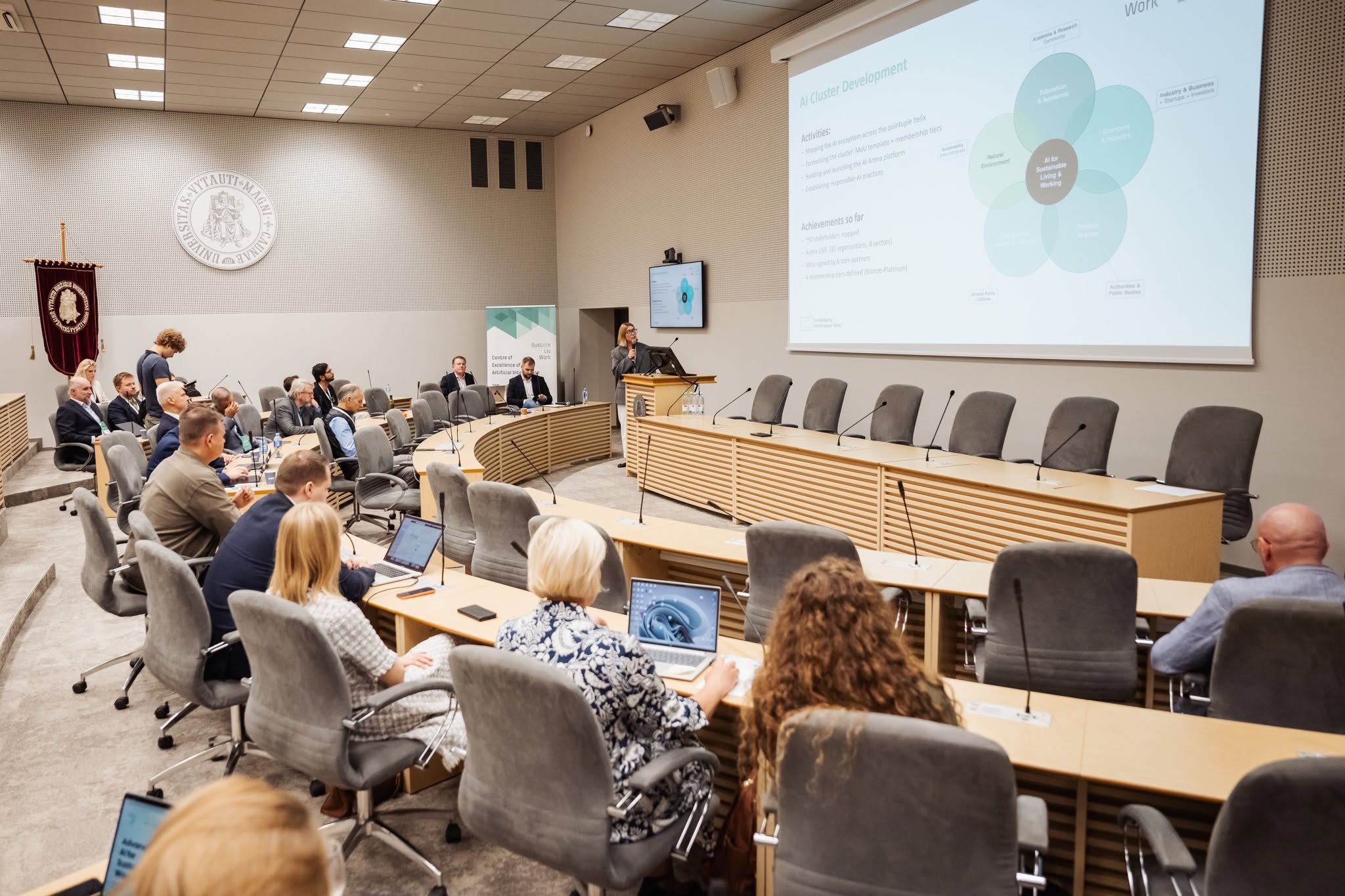
Prepared based on a presentation by Vilma Purienė, delivered during the “SustAInLivWork” annual meeting on September 17.
The “SustAInLivWork” project is co-funded by the European Union’s Horizon Europe research and innovation programme (Grant Agreement No. 101059903) and the European Union Funds Investment Programme 2021–2027 (Project No. 10-042-P-0001).
Galerija