
- Sustainability Hub
- Sustainability in university
Sustainability in university
Sustainability in university
The concept of a sustainable university reflects the position, mission, and role of Vilnius Gediminas Technical University in contributing to the development of a sustainability culture within the community and strengthening responsibility towards the environment, society, and the region.
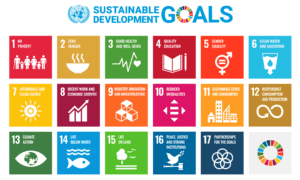
The University aims to contribute to the 17 Sustainable Development Goals adopted by the United Nations, covering areas such as social development, economic growth, environmental protection, and partnership.
-
Sustainable Development Goals
- End poverty in all its forms everywhere
- End hunger, achieve food security and improved nutrition, and promote sustainable agriculture
- Ensure healthy lives and promote well-being for all at all ages
- Ensure inclusive and equitable quality education and promote lifelong learning opportunities for all
- Achieve gender equality and empower all women and girls
- Ensure availability and sustainable management of water and sanitation for all
- Ensure access to affordable, reliable, sustainable, and modern energy for all
- Promote sustained, inclusive and sustainable economic growth, full and productive employment and decent work for all
- Build resilient infrastructure, promote inclusive and sustainable industrialisation and foster innovation
- Reduce inequality within and among countries
- Make cities and human settlements inclusive, safe, resilient and sustainable
- Ensure sustainable consumption and production patterns
- Take urgent action to combat climate change and its impacts*
- Conserve and sustainably use the oceans, seas and marine resources for sustainable development
- Protect, restore and promote sustainable use of terrestrial ecosystems, sustainably manage forests, combat desertification, halt and reverse land degradation and halt biodiversity loss
- Promote peaceful and inclusive societies for sustainable development, provide access to justice for all and build effective, accountable and inclusive institutions at all levels
- Strengthen the means of implementation and revitalise the global partnership for sustainable development
What has already been done at the University
-
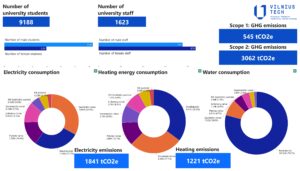
Energy and Emissions AnalysisData on the University’s fuel, electricity, and heat consumption have been collected, and the resulting CO2 emissions have been assessed and reported in accordance with the Greenhouse Gas Protocol, classified into Scope 1 and Scope 2 emissions. Calculations began in 2023, with the scope of assessed data gradually expanding. Future plans include the assessment of more complex Scope 3 emissions.
-
Emissions Calculation for 2024The University’s Scope 1 and Scope 2 emissions for 2024 have been calculated at 545 tCO2e/year and 3062 tCO2e/year, respectively. The carbon footprint is expressed in carbon dioxide equivalent. These values were obtained using consumption data collected from relevant University units and suppliers. Emission factors were based on scientific sources and official documents from public institutions for example Technical Regulation AR_2024-05-01.
-
Sustainability MonitoringA Power BI-based webpage has been developed to present a detailed breakdown of fuel, water, heat, and electricity consumption. Based on the calculated emission levels, recommendations will be provided on how to reduce the University’s emissions and resource use, and promote sustainable consumption. The University aims to achieve net zero emissions by 2050.
Photovoltaic Solar Power Plant
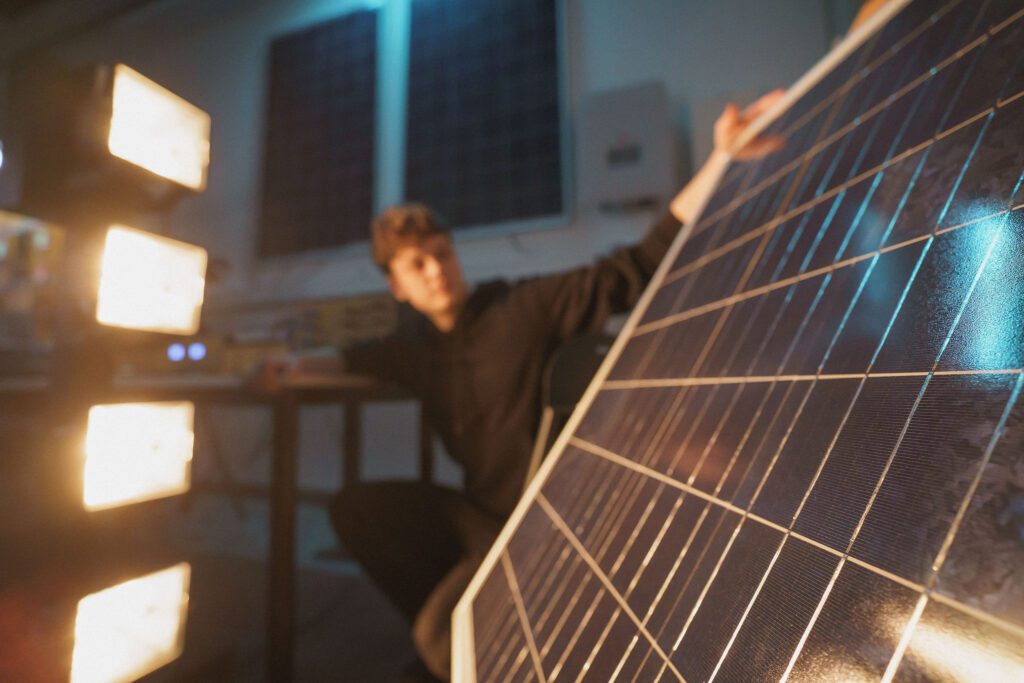
To reduce electricity consumption, six photovoltaic power plants with a total capacity of 429 kW have been installed at the Plytinė, Saulėtekis, and LinkMenų campuses. In 2025, only one plant was in operation for the full year, so the overall impact will be assessed after 2026. However, in 2025 the plants generated 186.94 MWh of electricity, which accounts for 4.05% of total electricity consumption.
-
429 kWPhotovoltaic Power Plant Capacity
-
186,94 MWhAnnual Photovoltaic Electricity Generation (2025)
-
4%Share of Electricity Generated by Solar Power Plants (2025)
The VILNIUS TECH Sustainability Centre demonstrates the University’s commitment to integrating sustainability into its core functions and serves as an example for other institutions seeking to strengthen their sustainability initiatives.