Myths and truth: what really determines success in a job interview?

March 27, 2026

The job search is often shrouded in various myths – that it’s only worth applying if you meet all the requirements, that extensive experience is the most important factor, and that in a job interview, you need to present yourself as the perfect candidate.

Such beliefs often hinder students and recent graduates from successfully launching their careers.

Inga Alimovienė and Rasa Vėgelė, project managers at the Organization Development Group of the Vilnius City Municipality Administration (VMSA), discuss the most common myths and what you should know before attending a job or internship interview.

First myth: If you don’t meet 100% of the requirements, it’s not even worth applying.

This myth might only hold true in cases of recruitment for a position strictly regulated by law.

“For example, if we are looking for someone for a position in public procurement, legal audit, or other legally defined roles, the selection process follows government-established rules. Therefore, we are obliged to invite all candidates who meet one hundred percent of the requirements,” explains I. Alimovienė.

In such instances, the selection is rigidly regulated, and employers have little flexibility in evaluating a candidate’s experience or education.

“It’s a different story when we’re hiring for positions that aren’t so strictly regulated, where we can be more flexible in looking at a person’s experience and education. In these cases, the job descriptions themselves are not as rigid – a degree in a specific field isn’t necessarily a must. Moreover, the job posting might even state that experience is not required, as we will provide all the necessary training,” she adds.

Meanwhile, R. Vėgelė emphasizes that it is worth applying for such positions even if you don’t meet all the requirements, especially for young people just starting their careers. According to her, during the job interview, recruitment specialists help assess a candidate’s suitability for a specific role. It also provides an opportunity for the candidate to better understand if they would find the job interesting.

“It’s important to remember that the job interview itself is a valuable experience. Every such meeting allows you to get to know yourself better, gain more confidence, and prepare for future opportunities,” she says.

Second myth: If you haven’t worked in a position for X number of years, you don’t stand a chance.

In this regard, the VMSA representatives assert that a candidate’s accumulated experience is far more important than the number of years worked. There are cases where individuals have never worked in their field of study but possess a wealth of knowledge gained through long-term practice in another area they are applying for.

“Specific requirements are more common for managerial, advisory, and other strictly regulated positions. For more junior roles, we recommend listing projects, working groups, and other activities you have participated in. We particularly stress this to students at career fairs – their experience, even from high school activities or student representation, reveals a lot about the functions they have performed, their interests, their proactiveness, and showcases their communication and other skills,” says R. Vėgelė.

Even experiences that seem minor at first glance can become a significant advantage on your resume – what matters is how you present them. Even brief entries can highlight important skills if they are described clearly, emphasizing the key aspects.

“You need to be able to self-assess – that experience, even if it seems insignificant to you, can be very revealing when presented correctly. For example, a student participated in an Erasmus exchange. This could be described in a single, simple line. But if they write that during the exchange they learned to collaborate with different cultures and teams, and improved their foreign language skills – this can already demonstrate certain advantages,” explains I. Alimovienė.

Third myth: In a job interview, you need to act out the best possible version of yourself.

Closely related to this myth is another: that there are right and wrong answers.

“This is a particularly misleading myth,” assures R. Vėgelė. Often, candidates trying to present themselves in the best possible light are eventually found out. She urges candidates to never lie and to be as open as possible.

“It’s very obvious when a candidate is lying. If you ask the same questions in different ways, they eventually get tangled up in their answers. Recruitment specialists can also sense when something is amiss. This becomes especially apparent when, for example, the first interview is remote and the second is in person. That’s when the truth really comes out,” she shares.

Trial tasks also reveal the truth about a candidate. There are instances where a person praises themselves during the interview but performs poorly on the task. Or, conversely, they excel at the task but, when asked during the interview, are unable to explain how they did it.

Nervousness during a job interview is natural and can hinder a good performance. However, according to R. Vėgelė, recruitment specialists understand and notice this and often try to help the candidate relax.

“Another example is lying about work experience. For instance, a candidate’s CV might state they are currently employed, but during the interview, it slips out that they are not. Or it might indicate they have been a manager for five years, when it later turns out they were promoted only six months or even a month ago. In such a case, it’s better to outline the career path, showing their growth from a specialist to a manager,” says I. Alimovienė.

Fourth myth: It’s impolite to talk about salary.

The topic of money is still largely considered taboo in Lithuania. Even in a job interview, candidates often shy away from clearly stating their desired salary. The specialists encourage applicants not to be afraid to name a figure, as everyone understands the need to cover rent or a mortgage, buy food and other necessities, and have some leisure. While not all companies may be flexible with negotiations, it is always worth trying after assessing your experience and potential.

“When applying, it’s important to pay attention to the salary range indicated in the job advertisement. If it aligns with your needs and experience, feel free to submit your CV. However, we definitely see cases where a person with no experience comes in and asks for the top of the salary range, which is typically earned by a specialist who has been in that position for several years. So, a realistic self-assessment is necessary,” says I. Alimovienė.

What else should you know when looking for a job?

“When it comes to your CV, the golden rule is to tailor it to the position you’re applying for. Don’t write that you’re looking for an accounting or administrative job if you’re applying for something in a completely different field. Also, be sure to double-check that your contact information is correct. We’ve had cases where people make a mistake in their phone number or email and then wonder why they haven’t received any calls after sending out a hundred CVs,” recounts I. Alimovienė.

If a cover letter is requested along with the CV, opt for a brief but sincere text tailored to the specific position, rather than a generic template sent to all companies. It is also crucial to carefully check who the letter is addressed to and ensure there are no careless errors.

When sending your CV and cover letter via email, clearly state which position, or at least which department, you are applying to. Companies are often hiring for multiple roles simultaneously, and it’s not always obvious from the resume alone.

“It’s also important to pay attention to your email address – one composed of your first and last name looks much more professional than an informal one created in your teens, like ‘strawberry123’,” says I. Alimovienė.

When going to a job interview, one of the most important things is to save the job advertisement. If you didn’t, it’s worth contacting the employer to ask for it – this demonstrates your interest and preparation. It’s also essential to research the company’s activities to facilitate conversation about the position and the organization during the interview.

Additionally, it’s beneficial to look into the company’s reputation by checking reviews, publicly available information, and employee posts on LinkedIn. It is equally important to assess whether the company’s values align with your personal expectations.

“For example, if a company’s value is collaboration, but an individual is unwilling to share their knowledge and train a colleague,” explains R. Vėgelė.

During the interview, it’s important for the candidate to ask about the job position, future responsibilities, and functions to ensure they have a correct understanding, and to ask for examples. You should also inquire about other important aspects like work flexibility, hours, remote work options, etc. If you forget, it’s worth following up with a call or an email, advise the VMSA specialists.

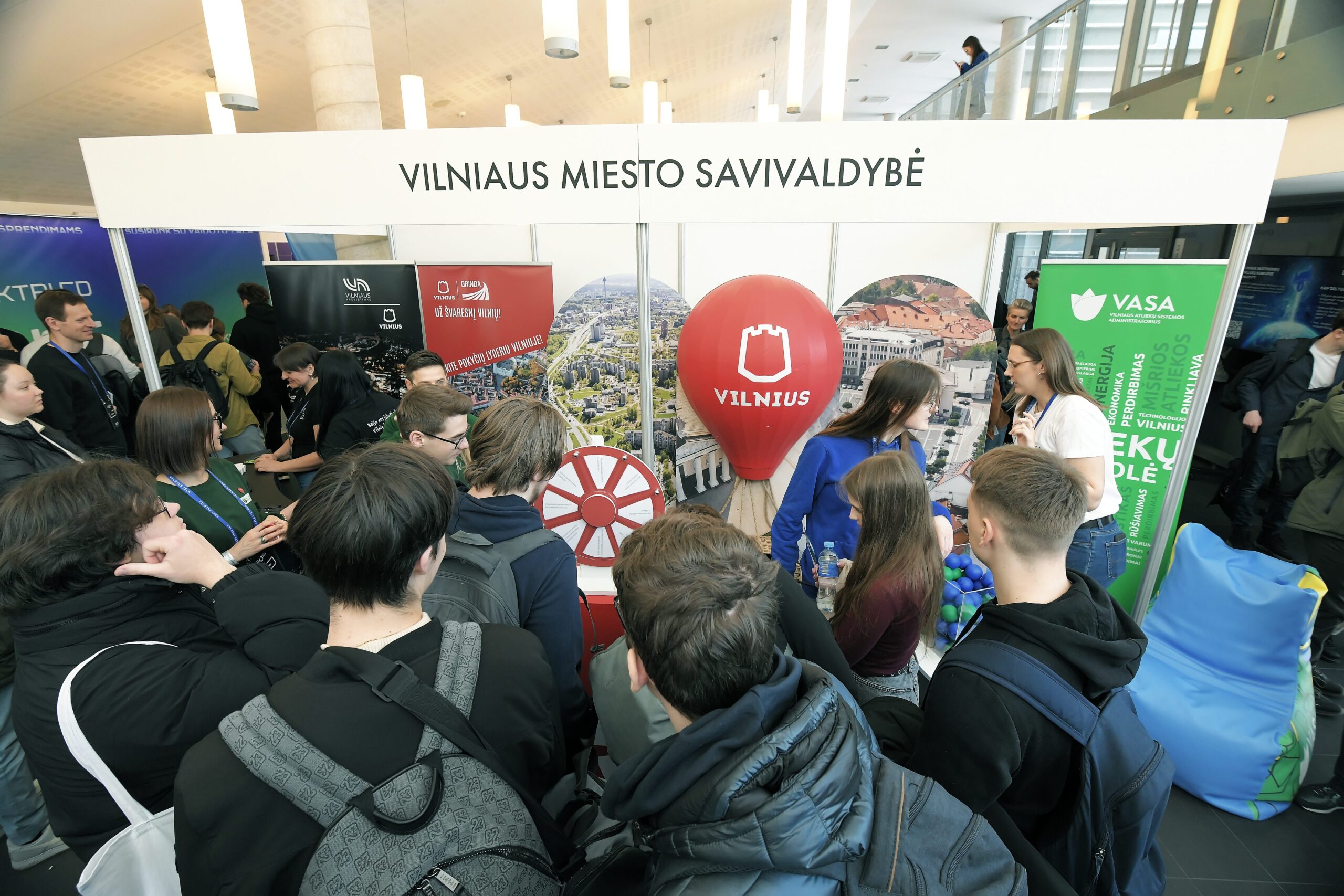
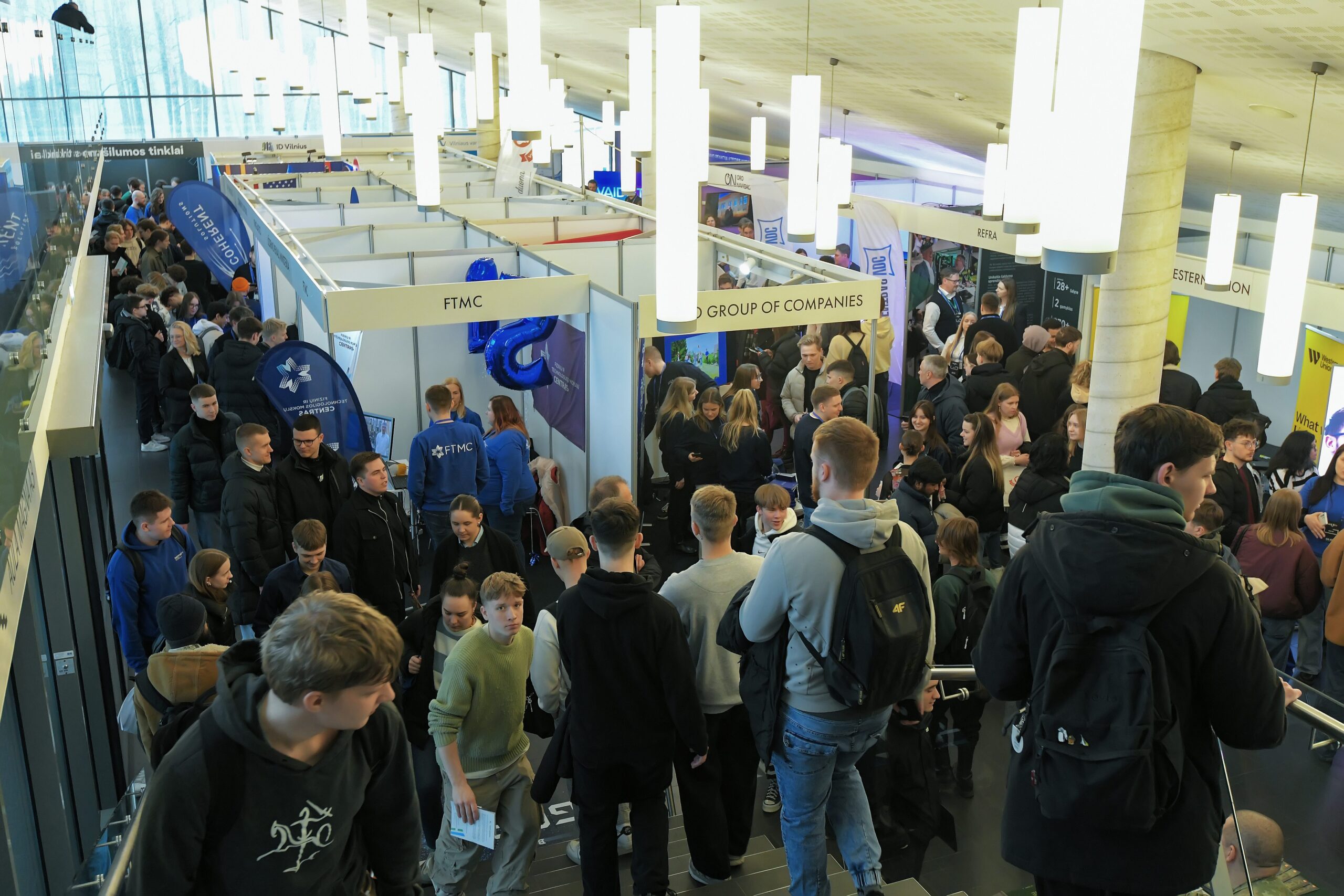
VILNIUS TECH invites young creators of the future to participate in the GRAVITY Career Day on April 16th. The event annually attracts over 10,000 students and high schoolers, and more than 100 organization representatives. It is an educational initiative that provides young people with real opportunities to explore professions, meet employers, and strategically plan their careers. This year’s theme is social connections. You can find more information about the event here.

Galerija
Related news

How We Will Strengthen Universities: Discussion at the European Parliament
At the conference “Investing in Europe’s Future: Funding Pathways for Higher Education,” held on May 6 at the European Parliament in Brussels, European policymakers, university leaders, representatives of regions and businesses, and research experts discussed the future of European higher education, the role of university alliances, and the need for long-term funding to strengthen Europe’s competitiveness. The conference was organized by ATHENA alliance member Maria Curie-Skłodowska University together with its alumnus and Member of the European Parliament Krzysztof Hetman. VILNIUS TECH also participates in the ATHENA alliance, working together with European partners to strengthen joint study programmes, research collaboration, international mobility, and the integration of European universities. According to Živilė Sederevičiūtė-Pačiauskienė and Asta Radzevičienė, who attended the event, considerable attention was devoted to the emerging role of European universities — university alliances are increasingly being viewed not as temporary project-based networks, but as future long-term European higher education institutions. In his keynote speech, Piotr Serafin emphasized that decisions regarding the new multiannual financial framework of the European Union after 2028 will have a long-term impact on Europe’s competitiveness, innovation policy, and university development. According to him, university alliances must become stronger, more integrated, and more closely connect studies, research, and innovation. Member of the European Parliament Krzysztof Hetman stressed that funding under the “Horizon Europe” programme is currently distributed unevenly, with around 85% of funding allocated to countries outside the “widening” group. In his view, this means that the European Union is failing to fully utilize its scientific and innovation potential. He noted that university alliances could become an important tool for reducing these disparities, strengthening interregional cooperation, and promoting innovation development across Europe. Anne Besnier devoted significant attention to the importance of regional innovation ecosystems and smart specialization. According to her, regions must clearly identify their strengths and build international cooperation networks based on them. She emphasized that collaboration among students and young researchers across Europe is gradually becoming the foundation for a common European innovation space. Bartek Czyczerski, CEO of Business & Science Poland, spoke about the transformation of the knowledge-based economy and the impact of artificial intelligence on the labour market. According to him, Europe’s main challenge today is not only preparing highly qualified specialists, but also ensuring that their competencies are fully utilized within the economy. He stressed that universities will need to shift toward more flexible, modular, and practice-oriented study models, where AI literacy, critical thinking, creativity, and lifelong learning will play a much greater role. Mariusz Głąbowski, Vice-Rector for International Relations at Poznan University of Technology and head of the EUNICE4U project, presented a model for the financial sustainability and governance of European university alliances. He emphasized that university alliances can no longer remain merely project-based structures dependent on short-term funding cycles. According to him, it is necessary to establish permanent structures integrated from legal, strategic, and organizational perspectives that could operate as genuine European universities. ATHENA European University President Eric Blond emphasized that a true European university cannot be built solely on student mobility. According to him, studies, research, and innovation must be integrated into a single common system. He also noted that ATHENA stands out because most of its partners come from “widening” countries — Lithuania, Poland, Greece, Portugal, Slovenia, and Ukraine. In his view, these countries should not remain on the periphery of European higher education, but instead become active leaders of Europe’s transformation. The conference featured extensive discussions on the development of joint European degrees, the European Student Card, the necessity of long-term funding for university alliances, and the connection between regional and European policies. Participants repeatedly emphasized that the development of university alliances requires a long-term political vision and a stable financial model that would enable the transition from pilot projects to fully functioning European universities. The discussions also highlighted that university alliances are becoming not only networks for studies or mobility, but also important actors in regional policy, innovation, and competitiveness. They are increasingly collaborating with businesses, regional authorities, European Digital Innovation Hubs, and other organizations in order to strengthen regional innovation ecosystems and create a common European knowledge space. Conference participants agreed that the key condition for the successful development of European universities is a long-term vision and a sustainable funding model that would allow university alliances to become fully-fledged European higher education institutions.
More
Dominykas Kneižys chose life at sea: "There’s always more to discover"
If you’re searching for Dominykas Kneižys, chances are he’s somewhere out at sea. Between the seven continents, countless countries, and remote islands he has visited, almost every destination has been reached by ship. Today, the VILNIUS TECH Lithuanian Maritime Academy alumnus serves as Staff Captain at National Geographic–Lindblad Expeditions, continuing a lifelong journey inspired by his love of the ocean. The long road to pursuing a dream Dominykas began sailing at the age of ten. What started as a casual after-school activity soon became his passion, his dream and ultimately his goal. His whole life began to revolve around sailing and water sports such as surfing and kitesurfing. Sometimes he would even skip school classes just to spend more time on the water or travel south to start the sailing season a little earlier. After finishing school, he faced a difficult choice: to pursue professional sailing with hopes of reaching the Olympics, or to study Marine Navigation, shifting from competitive sport to education and commercial shipping. Dominykas chose the latter – a decision that felt bittersweet at the time. [caption id="attachment_115617" align="alignnone" width="1920"] Dominykas Kneižys[/caption] During his studies at VILNIUS TECH, he took part in the Erasmus+ programme and spent a semester in Tenerife, Spain. “I managed to learn some basic Spanish and fell even more in love with open waters – I was surrounded by the vast Atlantic Ocean and spent most of my time close to the coast,” Dominykas recalls. “The following year, I applied for the Workaway programme and spent the summer season in Hawaii, working as a kitesurfing instructor on Maui.” As part of his studies, he also had to complete an onboard cadetship – a six-month journey on a tanker vessel. The experience, far from family, friends, and hobbies, made him realise that cargo shipping wasn’t for him. Dominykas knew he wanted to work on passenger ships or yachts. When an opportunity to work on a passenger vessel arose, he seized it – and that’s where his career as a Navigation Officer began. Yet it didn’t take long for him to understand that his true passion lay in exploring wild places and being surrounded by nature. A passion for nature and exploration pays off He quit his job and began looking for new opportunities. “I had a one-way ticket to Mallorca just as the COVID pandemic hit, and I got stranded on the island without any source of income – and without a home,” Dominykas recalls. “I found a farm to live on and went from yachting to farming! Feeding animals and cutting trees while searching for work. Luckily, I had some connections in the yachting industry, which helped me get back into it – and later into the sailing expeditions field.” Around that time, National Geographic-Lindblad Expeditions was building two new vessels and looking for experienced crew to deliver the highest standards of service. For over 50 years, this pioneering concept has defined expedition cruising. When Lars-Eric Lindblad led expeditions to Antarctica in 1966 and the Galápagos in 1967, he made history as the first explorer to bring private citizens to these extraordinary wildernesses. The launch of Lindblad Expeditions’ collaboration with National Geographic marked a new era in exploration. [caption id="attachment_115593" align="alignnone" width="1920"] Dominykas Kneižys[/caption] Today, the travellers can choose from more than 100 itineraries across all seven continents. The company operates an extraordinary fleet of expedition ships – among them the most advanced in the industry. “I had no experience in ice navigation or expeditions, but what got me onto the candidates’ list was my passion for watersports, extensive sailing and boat-handling skills, yachting experience with Power Boat certificates, and all the unlimited certificates required for a Navigation Officer on large passenger ships,” Dominykas explains. “It turned out they were looking for people passionate about nature and exploration – and I ticked those boxes.” Sailing with the wind – not against it Dominykas began as First Officer Navigation on the new National Geographic Resolution, which was then still under construction at a shipyard in Norway. Six months later, he transferred to another ship, National Geographic Orion, where he was promoted to First Officer Safety. A year later, he was promoted again to Staff Captain, continuing his journey of global exploration. “The ship I work on is a boutique-style, small expedition cruise vessel with all the amenities – luxury suites, libraries, a wellness centre, gym, bar, restaurant, diving equipment, military-grade inflatable boats (Zodiacs), kayaks, stand-up paddleboards, hiking gear, and more,” Dominykas explains. “The destinations we visit make this concept special. These vessels are highly manoeuvrable, built with strong hulls and a high ice class, capable of covering long distances in remote areas. The experienced crew make these expeditions even more exceptional – National Geographic photographers, expedition leaders, and divers from around the world join us on our journeys.” [caption id="attachment_115597" align="alignnone" width="2560"] Dominykas Kneižys[/caption] Among countless unforgettable experiences, Dominykas vividly recalls his first astonishing visit to Antarctica, sailing through the South Pacific from New Zealand all the way to Easter Island, visiting the world’s most remote places – French Polynesia, the Marquesas, and beyond. One of his most shocking memories comes from Papua New Guinea and West Papua: “Once, our ship was struck by lightning twice, the other time, we were stranded ashore with all the passengers in Australia surrounded by crocodiles and snakes,” the Staff Captain recalls. From all his years at sea, one key lesson stands out: never underestimate nature, and always sail with the wind – not against it. “The sea is my greatest passion – my provider, my profession, my hobby, and my love,” says Dominykas. “I wish everyone could find such a passion in life.”  
More