

We are pleased to inform that the latest 2025 values of the CiteScore metrics are already available on Scopus database (all data and indicators of all Scopus indexed periodical sources are freely accessible).
The principle of the CiteScore calculation is presented below:
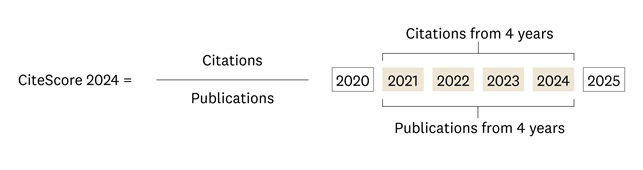
CiteScore values are indicated on the webpages of many journals and allows to objectively evaluate the quality of a publishing source.
Major advantages of CiteScore indicator:
- Comprehensive Coverage: Includes a wider range of publications compared to traditional metrics. It is calculated and provided for over 31,000 active titles. This broader coverage ensures a more complete dataset for evaluating journal impact.
- Fairness: Ensures a level playing field for different types of journals, including open access sources.
- Transparency: Offers clear and verifiable calculation methods.
- Timely updates: Provides more current data than some other metrics.
More information about the CiteScore indicator can be found in the Elsevier’s website.
Although by its meaning and calculation principle CiteScore indicator is relatively similar to a well-known Journal Impact Factor (JIF), the main CiteScore advantage over JIF is that CiteScore help you measure the citation impact not only for journals, but also for book series, conference proceedings and trade journals.
Important! Both CiteScore and JIF indicators are based on the average values describing the quality of the whole source (journal) and not of an individual publication published in it.
More information about Scopus and Web of Science database, their main indicators and their usage is available on the VILNIUS TECH Library’s webpage Scientific Communication sections: