


Home
About University
News
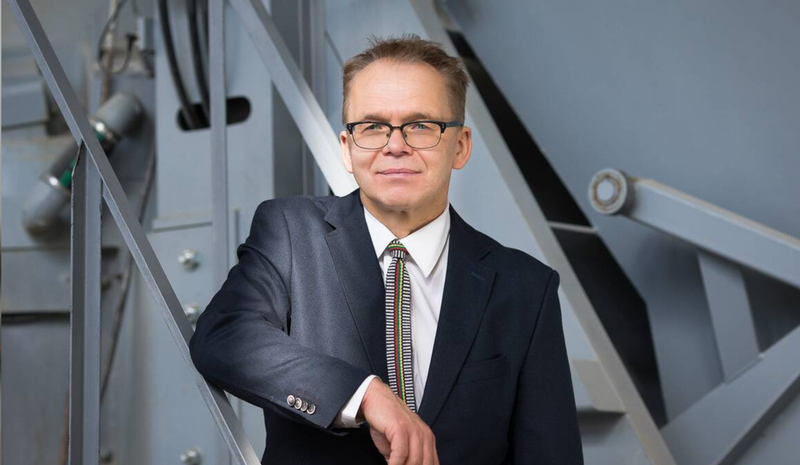
Prof. habil. Dr. G. Kaklauskas’ Journey: From Mathematics Olympiads to the Title of Emeritus
2026-01-06
Prof. habil. Dr. G. Kaklauskas’ Journey: From Mathematics Olympiads to the Title of Emeritus
The path of Prof. habil. Dr. Gintaris Kaklauskas, of the Department of Reinforced Concrete Structures and Geotechnics, into civil engineering began back in school—mathematics and geometry became not only favorite subjects but also the foundation for creative thinking. The example set by his parents, especially his mother—a civil engineer—helped him choose the direction to move towards. Today, after more than four decades of academic work, the professor shares his insights on the changes at VILNIUS TECH, the principles of creativity in science, and what motivates him to achieve his goals.
What is the path into engineering and the construction sector like?
I have always enjoyed the natural sciences at school, especially mathematics and geometry. I liked thinking, searching for solutions, and creating new things. I often solved problems prepared for competitions and participated in them regularly. As a teenager, I didn’t like memorizing things, yet in school, that was often required. In the upper grades, my math teacher frequently asked us to memorize formulas, even though I could easily derive them myself. I would rebel, refuse to memorize, and argue that rote learning stifles creativity. For these words, my teacher would lower my grades. The need for memorization, however, decreased significantly at university, where the focus was mainly on thinking and creative exploration.
My parents’ example also played an important role in choosing my profession as they both were engineers. My mother was a civil engineer and since I had a special connection with her I often saw her working - at the Urban Construction Design Institute in Vilnius, where she worked as a designer and sometimes at home. I saw how her colleagues respected her as a professional in her field and that she was happy with her choice of profession. I believe these two aspects shaped my own decision to study civil engineering at the then Vilnius Institute of Civil Engineering.
What does the title of Emeritus at VILNIUS TECH mean to you?
The title of Emeritus is a recognition of loyalty to the university and a continuation of one’s commitments.
Humans are naturally attached beings. Just as our loved ones or our homeland matter to us, we naturally form an emotional connection with our colleagues, the organization we work for, and its history. After graduating, I have worked at the university for over 43 years, except for a few years spent abroad on internships. My professional life has been intense, and I still take joy in it today. Loyalty has always been a value for me, even though it may not seem obvious to everyone nowadays. Upon reaching a certain age, the question naturally arises—what will I do next?
Even as a teenager, I planned my future, set goals, and pursued them. I hold a firm belief that both the body and the mind need daily exercise. I have long known that I wanted to continue my academic career for as long as possible. As a professor and senior researcher, I value scientific work, collaboration with colleagues in Lithuania and abroad as well as the opportunity to pass on my experience to the next generation—to mentor future scientists. I will be able to continue these activities as an Emeritus.
Moreover, Emeritus status provides more freedom to engage in what truly brings me joy. At present, I constantly feel a subconscious ticking counter measuring annual scientific output, even though, in reality, novelty—not the number of publications—is what truly matters in science. Unfortunately, many researchers today are enslaved to mere metrics. I hope that as an Emeritus, I will be able to devote myself even more fully to creative exploration.
How has VILNIUS TECH changed over the years?
I began my scientific career during the Soviet era. Lithuania was under occupation, Soviet ideology prevailed, the occupiers’ language was imposed, various restrictions were in place, and the system was autocratic. It’s easy to imagine that, over the decades I have worked at the university, there have been truly many changes. I would like to focus primarily on studies, science, and the academic community.
Studies. In my opinion, civil engineering studies at the then Vilnius Institute of Civil Engineering were genuinely high-quality. Our course alone had 14 groups. At that time, students generally did not work and could dedicate their full attention to their studies. I had many excellent lecturers—they were true professionals in their fields.
Science. I will start with doctoral students (then called aspirants). During the Soviet period, competition for doctoral studies was enormous. Only a few departments trained scientific doctors (then called “candidates of science”), so only the very best graduates were admitted to doctoral programs. Many had the opportunity to test their scientific abilities in the Young Scientists’ Society, which actively organized conferences and various competitions. The activity of young scientists at that time was significantly higher than it is today.
The high attractiveness of the scientific profession during the Soviet era was largely due to high salaries. An associate professor earned almost four times more than an engineer, a full professor six times more, and an academician up to eight times more. Doctoral students were motivated—they worked not only on weekdays but also in the evenings, on weekends, and during their holidays. However, the system did not encourage scientists to publish their work. Associate professors, for instance, in five years only needed to prepare two publications in local journals. Almost no one wrote for Western journals, let alone top-tier ones. There were no opportunities for internships, teaching, or participation in conferences abroad. We also lacked the modern experimental equipment that is available to us today.
What motivates you to pursue your goals?
I’ll answer briefly: my aim is to be happy.
We are all very different by nature and upbringing. We have inner needs, and our happiness often depends on whether these needs are met. Some people in life seek as little stress as possible and are content with a secondary role. Others are happy only when they achieve significant results in their professional life. I belong to this latter group. That is why it has always been essential for me to have a goal and pursue it—whether in sports or professional activities. If a day ever comes when I no longer have ambitions in science, I am sure I will find a new field in which I want to grow rapidly.
In pursuing goals, I like to live intentionally: exercising daily, taking cold showers, and eating healthily. I greatly value recognition from loved ones and colleagues—it gives meaning to my professional work. I also care deeply about the well-being of society. I spent a year on an internship at the University of Illinois at Urbana–Champaign in the United States. I was the first VILNIUS TECH scholar to receive the prestigious Fulbright fellowship. I was offered a permanent position there, but even in the wealthiest country in the world, I saw so many unhappy people that I realized I would never feel truly at home there. I have always wanted to live in Lithuania and work at my Alma Mater.
What creative principles have you applied or do you apply in your scientific work?
Creativity is a set of abilities that allows one to generate and successfully implement new ideas. In my scientific work, I rely on several fundamental principles of creativity:
Original perspective and courage. One of the most important traits of a creator is having a distinctive and original viewpoint. Such a person must not simply follow the majority’s opinion but form their own values. This requires strong inner confidence and, most importantly, courage. New ideas always face resistance—opponents usually outnumber supporters, and their number often correlates directly with the originality of the idea. There is always the risk of being wrong. If a new concept published in a prestigious journal is later disproven, it can severely damage a scientist’s reputation—the bolder the hypothesis and the higher the journal, the greater the potential harm. Therefore, courage is an essential quality of a creator.
The value of “not knowing.” When creating something new, we rely on our existing knowledge, but I firmly believe that knowing too much can hinder creativity. The more you know about a topic, the lower the chance of developing a genuinely new theory. When tackling an ambitious theoretical model, I consciously avoid delving too deeply into existing methods—this is one of my creative rules. Paradoxically, the doctoral requirement to start with a literature review does not suit all creators. Of course, once a model is developed, a comprehensive analysis and comparison are necessary. Still, I worry that artificial intelligence might suppress creativity—after all, it’s so easy to ask and instantly get an answer instead of searching for it yourself.
Tolerance and flexible thinking. Another crucial aspect of creativity is the ability to remain open to various assumptions. A rigid researcher will rush to dismiss a hypothesis that could be entirely rational. I believe that a creator, in defending a new idea, often represents a minority, therefore, one should also be tolerant of other minorities and unconventional approaches. Flexible thinking helps avoid premature rejection and discover what initially seems unusual or inconvenient.
Intrinsic motivation and idealism. Inner motivation, passion, emotion, and the joy of creation are the driving forces that allow one to pursue results persistently. I believe that true scientists are idealists—they are driven by ideas, not material gain. However, maintaining this idealistic tone requires support from loved ones, as it provides meaning and inner strength.
Work intensity and endurance. The search for solutions is continuous—from morning to evening, sometimes at night, for weeks or months, on weekends, and even during holidays. During these moments, one can become almost obsessed, the sleep gets disrupted. Physical and mental endurance are essential for creative work. Sports, walks, working in the park, at an airport, or on a plane allow one to step back from routine and focus completely. It is often in these moments that the subconscious mind offers a solution—a flash of insight, the moment of illumination when a new idea is born.
Creativity as detective work. Scientific creativity reminds me of a detective’s work: you examine the first segment of a chain, look for connections, generate assumptions, test and reject them, formulate new hypotheses, and test again. After analyzing one segment, you move to the next. Gradually, a model or theory emerges. Unfortunately, in 99 out of 100 cases, the model turns out too complex or inaccurate, and you must start over. Creativity in scientific work requires patience, perseverance, and consistent improvement, which, although often invisible, ultimately leads to a qualitative leap.
-
- Page administrators:
- Monika Daukintytė
- Monika Daukintytė
- Ugnė Daraškevičiūtė