


Home
About University
News
Professor Dr. Algis Mickunas: “Life begins when you understand that you only have one”
2025-12-29
Professor Dr. Algis Mickunas: “Life begins when you understand that you only have one”
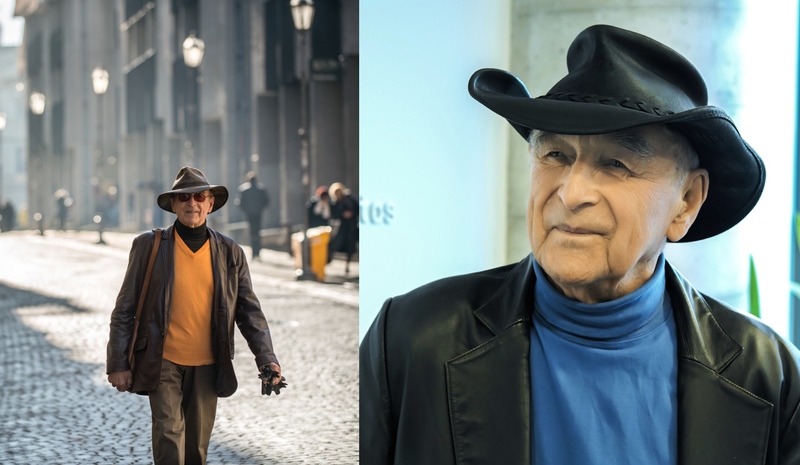
“My calling is to teach,” says the world’s most widely known philosopher of Lithuanian origin, author of several dozen books, and VILNIUS TECH Honorary Doctor, Prof. Dr. Algis Mickunas. The 92-year-old professor, who has educated hundreds of scholars, is a true inspiration, proving that listening to the voice of your heart is one of the best decisions a person can make: through his faith and love, he connects people of different generations, nationalities, religions, and worldviews all over the world.
Living in the United States and lecturing in many countries, Ohio University professor Dr. A. Mickunas is also well known to the VILNIUS TECH community – he comes almost every year to teach students of the Faculty of Creative Industries.
This year, after presenting a lecture cycle titled “Communication and Creative Imagination,” the professor also found time for an inspiring conversation, during which he shared thoughts about a teacher’s duty and ability to create togetherness, the courage to live, and the unexpected events that often turn out to be life’s greatest gifts.
Professor, you have taught many generations of students. How would you describe today’s youth? What interests them, and what no longer does?
Everything depends on the teacher. Sometimes fellow professors complain that students are bad – they want nothing, they are uninterested, they do not read, nothing matters to them. Then I ask – and what would the students say about you? They would say the same.
We should not say that students are lazy or do not listen, but rather understand how to communicate with them and how to speak so that they would listen.
It seems that you do not face such problems – your students are attentive listeners. How do you manage to build such a connection and unite different generations?
The most important thing is dialogue. I succeed because I always listen to students – when you show interest in them, they want to talk. I have trained more than 100 professors, and I communicated with all of them day and night, no matter what. I am open even after lectures – instead of running off, we go to a cafe, and we keep talking and discussing.
Also, I am not afraid to be wrong, because we all make mistakes, and I am not afraid of being corrected. Not only students learn – I always learn too, we learn from each other. That is part of my work.
Still, many people, especially young ones, are afraid to discuss, ask questions, or share their thoughts, because they do not want to sound foolish or naive and be criticized.
I do not criticize students and do not tell them they have not learned something, understood something incorrectly, or are thinking wrongly. When a student writes or says something, I praise them, emphasize that it is very important and meaningful, and encourage them to consider how the topic could be developed further.
When I go to another country, I first ask people how they live, how they think, what their traditions are, what they eat, and so on. When you understand their world, powerful dialogue emerges.
You travel a great deal – Lithuania is just one of many countries where you share your knowledge, experience, and wisdom. Do you notice big differences between young people in different countries, or are they, regardless of nationality, citizenship, religion, or culture, interested and concerned about similar universal human things?
First, we must understand that we are all human, regardless of how others describe us or how we describe them. We must avoid ethnocentrism, racism, even religious barriers, and avoid assuming that if others think differently, we cannot understand one another. When we acknowledge that we are the same despite differences in skin color, language, or anything else, communication becomes easy. And we need to speak, because none of us are absolute bearers of truth or perfect sages.
It seems you truly enjoy and believe in what you do. This is relevant to many people who, when choosing a profession, struggle between two poles – whether to choose a well-paid, promising job that may not bring joy, or a beloved, interesting field that may not guarantee financial comfort. These things do not always align.
The main rule is that if your career matches your life’s passion, you will never work.
And do you work?
I am a teacher. I do not work at all, and I want nothing more than to read, learn, talk, and share. People ask me: “How much do you earn?” I do not care (laughs). Being a philosophy lecturer is my pleasure, and they even pay me for it.
Today’s consumer society often focuses on tangible, material things – money, objects, achievements, titles – but at the same time longs for a sense of meaning. What is meaning to you personally?
And what will you do with all those riches? For me, meaning is to be a teacher and to keep learning without stopping. At the moment I am very interested in astronomy and space, so I constantly talk with astronomers, and I share what I learn with students. I do not own anything valuable myself, but the world is very interesting, so I want to open it and share it.
The best researcher must also be the best teacher – he must share what he discovers, not just sit in his laboratory. I often say that a teacher is like a mountain climber who leads people into the mountains: he does not climb over them but lifts them higher above himself. That is my duty and goal – to teach, to lead, and to elevate others. That brings me joy.
For example, I always try to lift my doctoral students higher. When I write a book or an article, I encourage them to contribute so that their names appear next to mine – it helps their careers. Now I supervise doctoral students from VILNIUS TECH – I will contribute to their work and advise on how to publish it.
Also, about five years ago, with students from Pasvalys’ Petro Vileisis Gymnasium, we created a youth group – my archive was established in the M. Katiliskis Library, a philosophy center was founded, together with the students we started organizing conferences. They prepare presentations on certain themes, and later we discuss them. We will edit and publish all five conference sets of presentations, nearly 60 in total, which are supposed to make students feel that we matter. This book, with the participation of several Pasvalys students and teachers, will be presented at the Book Fair.
It is clear that you have found your calling. How did you manage to do that?
I found it without searching. I had a friend in Chicago who attended school in the evenings and what was I supposed to do at that time? I walked around. One evening, while walking, I saw a university and went inside. They offered open lectures – languages, sociology, philosophy. I thought – why not, and signed up for it, even though I had long finished engineering studies and was already working. One semester passed – interesting; another semester came – even more interesting. I studied for pleasure, out of curiosity, without any goal, until I earned a bachelor’s degree in philosophy. Then I received an invitation to study for a master’s degree in Germany. I thought I would return to engineering after studying there, but then I was offered a PhD scholarship in the US.
What do you think ultimately determines the direction of our lives – fate, randomness, circumstances, or our own decisions?
Many things influence your fate, but you can refuse them. I was an engineer with a promising career ahead. Before that, I could have had a good career in the army, where I was offered to stay. I was 19 then, and at 39 I would have retired and could have done whatever I wanted. But I decided to explore the world and maybe find another career path. This happened by accident when I walked into the university – if I had crossed the street instead, I would not have entered. Life is a surprise, full of unexpected events and opportunities.
Still, the fear of taking a risk, making a wrong decision, and not being able to turn back troubles many people. Is it worth giving up interesting adventures and sticking to a strict life plan?
In that case you become very narrow – you have nothing and see nothing except that plan. It will not come true anyway, because the environment and relationships with others influence us.
On the other hand, adventures bring a lot of uncertainty, which sometimes brings pleasant excitement, sometimes anxiety. At the moment, due to various global problems and unstable geopolitical situations, anxiety is especially high. How would you advise dealing with uncertainty? How do we accept it?
We must understand that events that seem terrible now eventually exhaust themselves. Everything passes in time.
There is a Zen story. A young man asks his father to buy him a horse. The father says: “Oh child, you do not need one.” The son insists. What can the father do – he buys it. The young man is happy and the father is happy that the son likes it. He asks a Zen master: “Isn’t this good?” The master replies: “We will see.”
Things go well, the young man rides the horse, but one day he falls and breaks his leg. The father says: “Oh, how bad that I bought the horse, now my child broke his leg.” The Zen master says: “We will see.”
A war begins. Young men are drafted, but this young man does not have to go because his leg is broken. The father says: “Oh, how good we bought the horse, how good that he broke his leg, now he will not go to war.” The Zen master says: “We will see.” So you can predict nothing in life, and maybe you should not try.
From what you’ve said, it seems that life requires openness and courage to follow its flow. Do you also avoid planning and simply follow curiosity and your heart?
I go where the world leads me. Everything is interesting, everything brings joy. I do not know how to be angry. If I try to get angry, I end up being angry at myself – I say, you fool, what are you doing? Why jump and get angry… As we used to say in the village – you cannot jump higher than your belly button. Besides, we all have two lives: the second life begins when you understand that we only have one.
-
- Page administrators:
- Monika Daukintytė
- Monika Daukintytė
- Ugnė Daraškevičiūtė