


Home
About University
News
VILNIUS TECH's living concrete on the LNDT roof: the first time such material is being used
2025-12-19
VILNIUS TECH's living concrete on the LNDT roof: the first time such material is being used
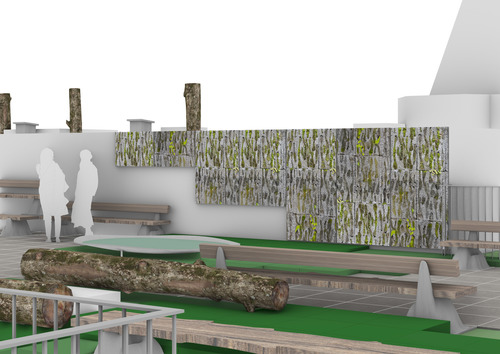
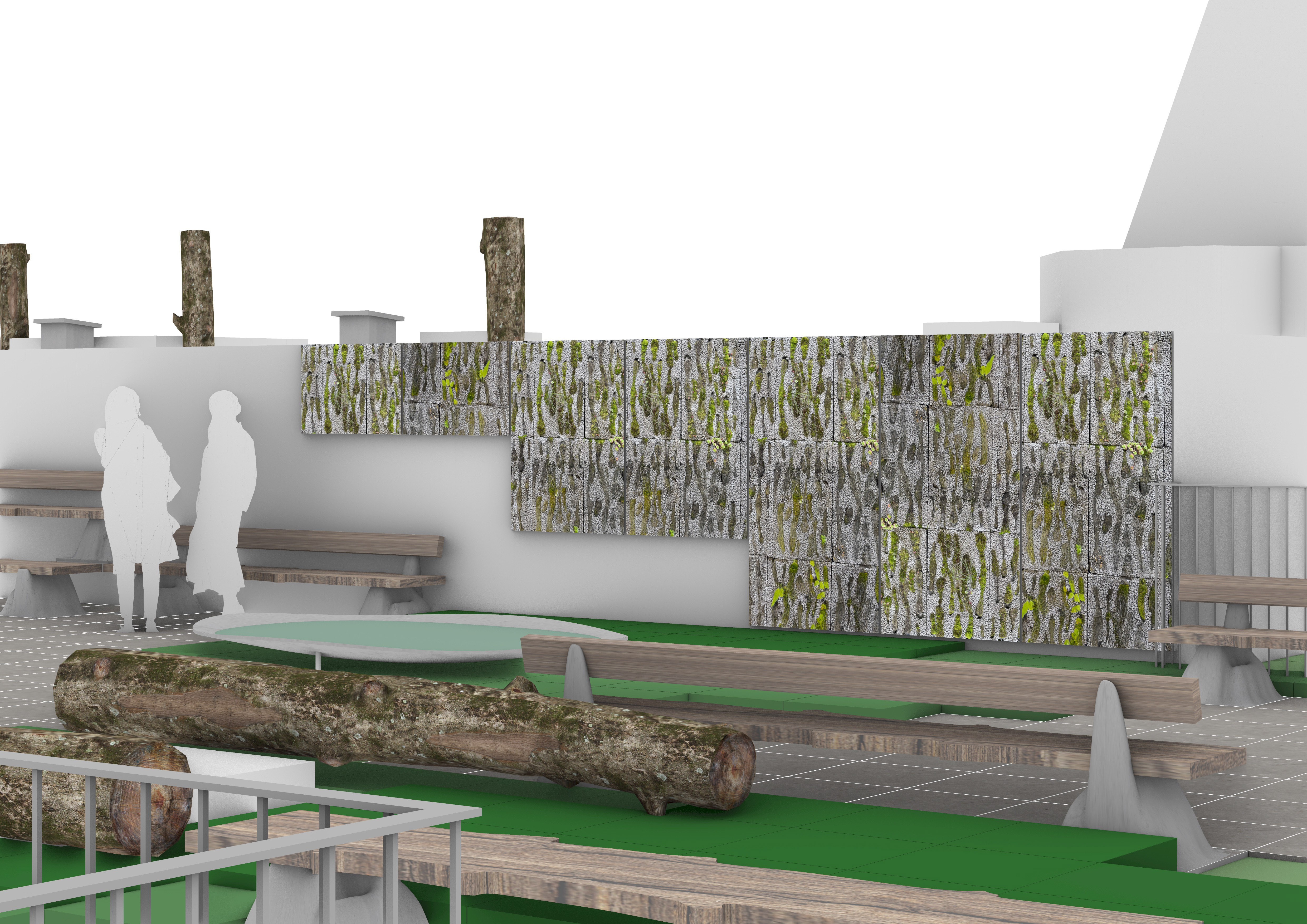
In the heart of Vilnius Old Town—on the roof of the Lithuanian National Drama Theatre (LNDT)—a unique green space will bloom next year. The "Roof Garden" project will combine culture, science, and nature. It will feature not only natural vegetation characteristic of Vilnius, visually extending the city's green spaces, but also unique biologically active concrete developed by VILNIUS TECH researchers. There are only a few examples of this material's use worldwide, and this marks the first time it has been applied in Lithuania.
Living Concrete: More Than Just a Building Material
The LNDT roof, which has been unused, covered in bitumen, and prone to extreme heat in the summer, will transform into a green space designed for theater staff relaxation and public events. However, this will not be a traditional, meticulously maintained garden with flowerbeds. The project’s vision is to create a natural, self-forming, and self-sustaining ecosystem where local vegetation reigns and the boundaries between human creation and nature gradually fade.
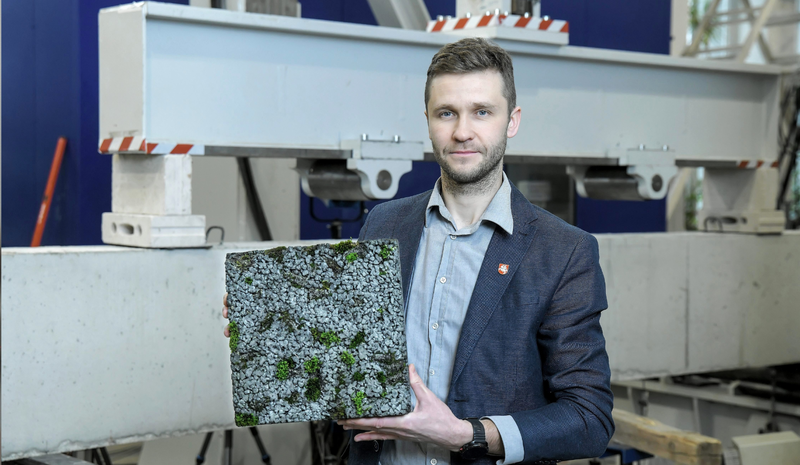
One of the most interesting elements of this project is the biological concrete developed by researchers from the VILNIUS TECH Building Materials Institute and the Laboratory of Innovative Building Structures, which fundamentally changes the perspective on construction materials. Plans include building an experimental wall and small architectural elements—such as benches and pots—from this concrete on the theater roof.
In cities, ordinary concrete is often considered "dead," and any darkening or moss appearing on it is viewed as dirt that needs to be cleaned. Meanwhile, VILNIUS TECH researchers aim for the opposite effect—creating a surface that is "living," i.e., biologically active.
"The concrete we are developing naturally attracts life from the environment—microorganisms, microalgae, bacteria—and creates favorable conditions for them to settle and thrive. Over time, it becomes overgrown with lichens, mosses, fungi, and even certain plants," says Assoc. Prof. Dr. Ronaldas Jakubovskis, a researcher at the Laboratory of Innovative Building Structures.
This means that the concrete becomes a kind of canvas for nature, which changes over time, lives its own life, and requires no constant human intervention or use of chemicals.
According to the researcher, the properties of this concrete are carefully programmed in the laboratory: its pH, porosity, surface roughness, and water permeability are all regulated. The surface topology is also crucial—special ornaments and grooves direct water so that it reaches growth zones rather than simply flowing away, forming specific patterns on the wall.
Benefits for the City: From Cooler Air to Noise Reduction
The use of biological concrete in the city creates both aesthetic and practical value, especially in the field of sustainability. Assoc. Prof. Dr. R. Jakubovskis emphasizes several key benefits that these "living" facades can provide to urban areas.
"First and foremost is temperature regulation. Concrete covered in moss or lichens heats up several degrees less in the summer than a bare surface. This can significantly—by up to 20%—reduce building cooling costs," the researcher states.
Furthermore, such a surface acts as a natural filter, absorbing atmospheric particulate matter and participating in carbon and nitrogen cycles, thus contributing to improved air quality. Another highly relevant feature in a noisy city center is improved acoustics. An uneven, vegetation-covered surface absorbs sound much more effectively than smooth concrete or glass.
A Long-term Experiment in a Public Space
The architectural principles for using biologically active concrete were formulated about 10 years ago by Prof. Marcos Cruz (University College London), but there are very few real-world applications globally. In Vilnius, this will be the first public experiment of its kind.
"For us, this is a unique opportunity to step outside the laboratory. We will be able to observe how the material behaves in a real environment, and how it changes over time and through the seasons. It will be living proof that city facades can be different—not sterile, but evolving and vibrant," says Jakubovskis.
The renovated roof terrace, featuring the garden and experimental concrete elements, is planned to open to visitors next summer. It will serve not only as a place for rest but also as an educational space, inviting people to rethink our relationship with urban nature and the architecture of the future.
.jpg)
.jpeg)
.jpg)
-
- Page administrators:
- Monika Daukintytė
- Monika Daukintytė
- Ugnė Daraškevičiūtė

.jpg)
.jpeg)
.jpg)