

Home
For international students
A VILNIUS TECH Researcher’s Chip – an Innovation for Transport Electronics
2025-12-12
A VILNIUS TECH Researcher’s Chip – an Innovation for Transport Electronics
VILNIUS TECH Faculty of Electronics doctoral student Lukas Šalavėjus has developed an innovative integrated circuit addressing key challenges in the transport and communications sectors. His work represents not only a personal achievement, but also the result of close collaboration with universities and high-tech companies in Taiwan, opening new opportunities for Lithuania’s electronics industry.
A Universal Solution for the Transport Sector
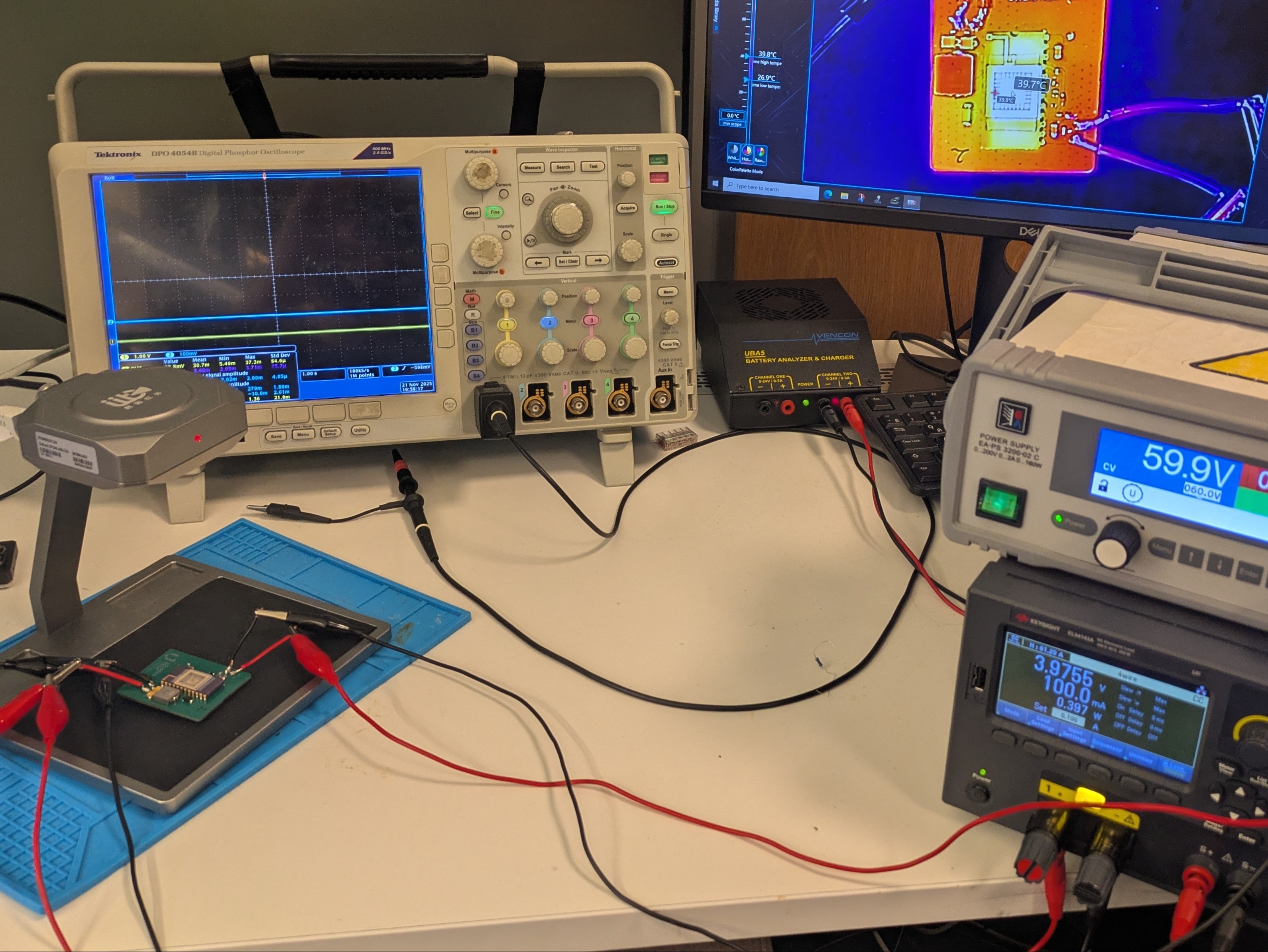
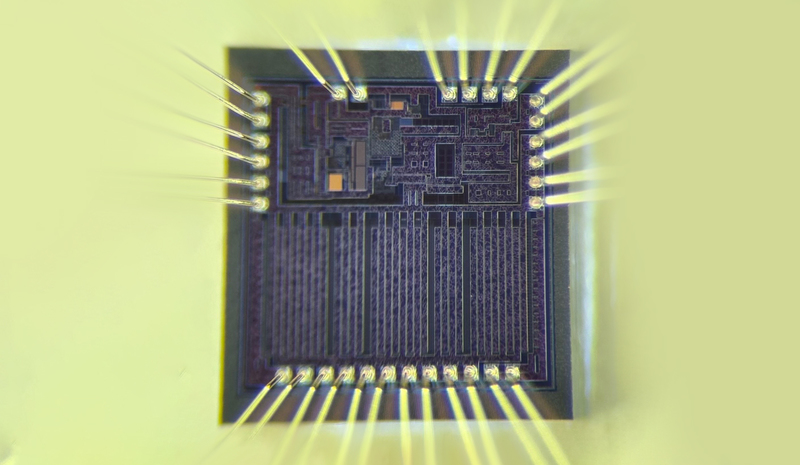
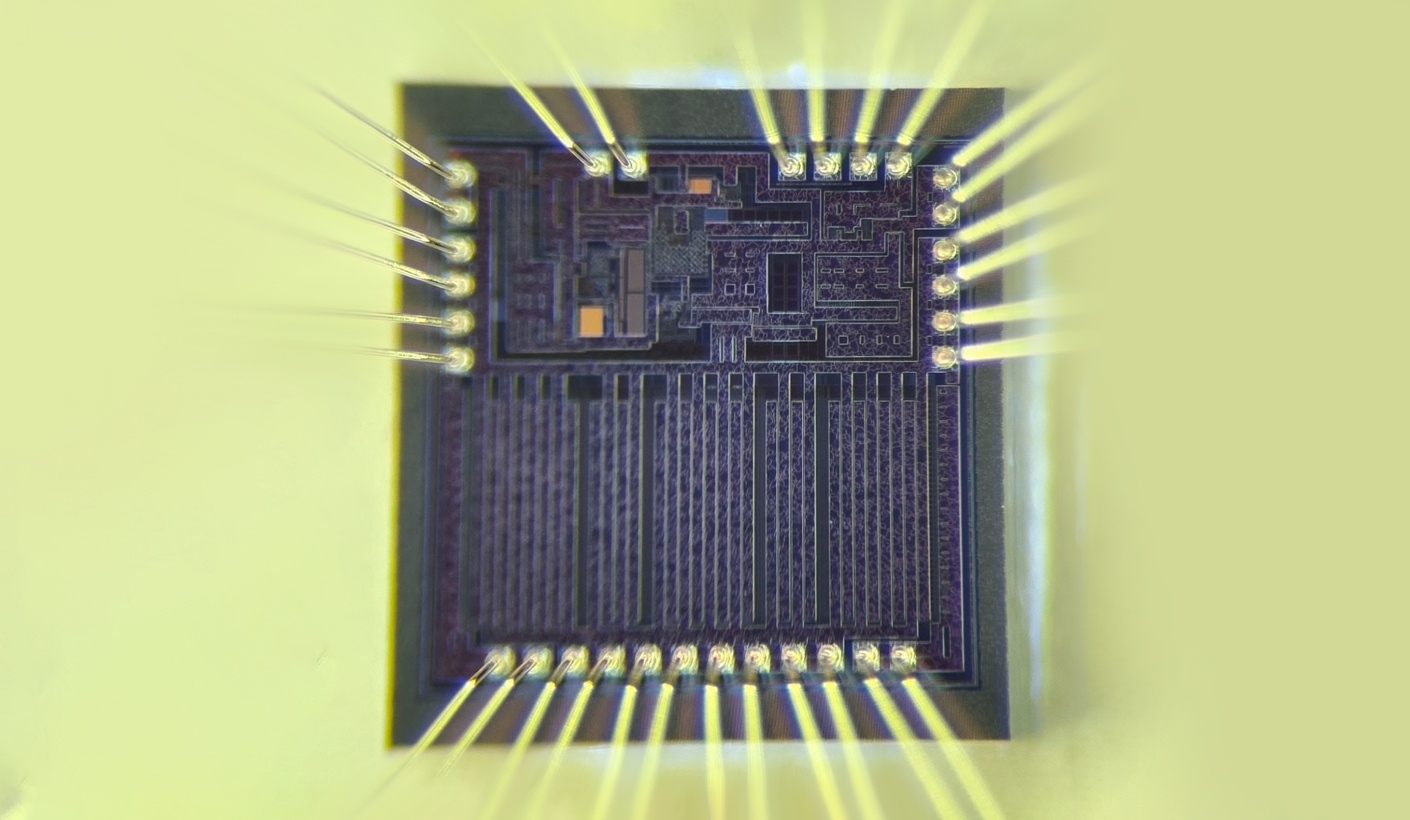
The chip developed by Šalavėjus is a buck (step-down) converter. Such chips are among the most widely used integrated circuits—they are needed in virtually every device that has a battery or operates on varying power sources.
According to the developer, his goal was to create a reliable 4 V power supply for communication modems used in 2G–5G equipment that could operate across an exceptionally wide input voltage range.
This is particularly important in the transport sector, where different vehicles use different power systems. For example, passenger cars use 12 V, trucks and buses 24 V, while hybrid cars, electric bicycles or scooters rely on 48 V batteries.
“My solution enables the formation of a stable output voltage from an 8–60 V input. Thanks to such a wide range, a single electronic device using this chip—such as a GPS tracking unit—can be used in various types of vehicles. The chip automatically adapts to different power sources and ensures stable and efficient operation,” explains the VILNIUS TECH doctoral student.
Inspired by Real Market Needs
The idea to develop such an integrated circuit emerged from Šalavėjus’s experience working in the electronics industry and designing equipment for the automotive sector. According to him, although Lithuania is home to strong, globally competitive electronics design and manufacturing companies and the demand for chips is enormous, many key components still have to be imported.
“I wanted to contribute to a future where we can design more crucial electronic solutions here in Lithuania—and perhaps one day manufacture them too,” he says.
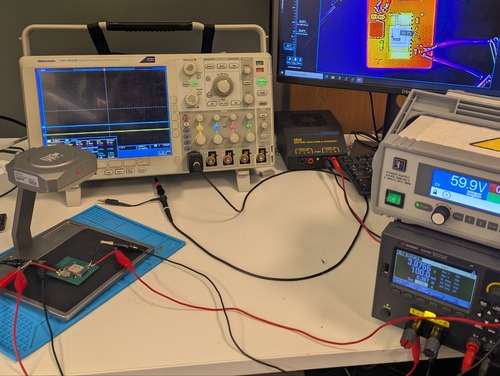
By creating this solution, he gained comprehensive competencies covering the entire design process, as well as hands-on experience testing the manufactured chip under real-world conditions. He had to overcome multiple challenges, particularly integrating several complex domains—analog electronics, power electronics and high-voltage technologies.
“The most challenging part was ensuring that the high- and low-voltage circuits inside the chip operate safely and without interfering with each other. The high-voltage parts must withstand up to 60 V, while the low-voltage control logic operates at just a few volts. This required extremely careful design of how these circuits are isolated and how they interact safely,” Šalavėjus explains.
His doctoral supervisor, Prof. Dr. Vaidotas Barzdėnas, Head of the Department of Computer and Communication Technologies at VILNIUS TECH, emphasizes that this achievement is an excellent example of how a unique engineering idea, perseverance and focused work can lead to the realization of even the most complex chip design ambitions.
He notes that no one should fear tackling advanced technological fields—Lithuanian universities are fully prepared to help, train and transfer cutting-edge knowledge and technologies to industry.
“Our infrastructure, partnerships and competencies are strong. The most important step is to boldly move into chip design and high-tech domains. These fields pave the way for solutions in transport, computing, communication systems and other strategic sectors,” says Prof. Barzdėnas.
“I wanted to contribute to a future where we can design more crucial electronic solutions here in Lithuania—and perhaps one day manufacture them too,” he says.
By creating this solution, he gained comprehensive competencies covering the entire design process, as well as hands-on experience testing the manufactured chip under real-world conditions. He had to overcome multiple challenges, particularly integrating several complex domains—analog electronics, power electronics and high-voltage technologies.
“The most challenging part was ensuring that the high- and low-voltage circuits inside the chip operate safely and without interfering with each other. The high-voltage parts must withstand up to 60 V, while the low-voltage control logic operates at just a few volts. This required extremely careful design of how these circuits are isolated and how they interact safely,” Šalavėjus explains.
His doctoral supervisor, Prof. Dr. Vaidotas Barzdėnas, Head of the Department of Computer and Communication Technologies at VILNIUS TECH, emphasizes that this achievement is an excellent example of how a unique engineering idea, perseverance and focused work can lead to the realization of even the most complex chip design ambitions.
He notes that no one should fear tackling advanced technological fields—Lithuanian universities are fully prepared to help, train and transfer cutting-edge knowledge and technologies to industry.
“Our infrastructure, partnerships and competencies are strong. The most important step is to boldly move into chip design and high-tech domains. These fields pave the way for solutions in transport, computing, communication systems and other strategic sectors,” says Prof. Barzdėnas.
Experience in the World’s Chip Capital Contributed to Success
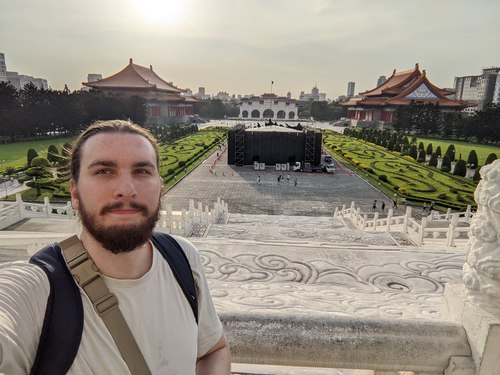
A significant factor in the success of Šalavėjus’s project was VILNIUS TECH’s collaboration with Taiwanese researchers. Over the past three years, he spent about four months in Asia participating in scientific internships, intensive training and working with the team at NSYSU University.
“Taiwan is truly the world’s chip capital, where the technological ecosystem functions as a single, well-coordinated mechanism. Universities work closely with research institutes and leading chip manufacturers such as TSMC and UMC.
This experience changed my perspective on scientific processes and work culture—seeing how fast and productively projects can be carried out when universities, industry and research centres collaborate inspired me to pursue higher quality, experiment more boldly and think globally,” the young researcher shares.
Still, the biggest difference between Lithuania and Taiwan lies in the scale and specialization of research and production. According to the doctoral student, chip engineering in Taiwan is one of the country’s most important technological fields. For this reason, universities operate many more chip laboratories, each specializing in a specific area—analog electronics, digital logic, high-frequency circuits, power electronics or photonics.
“These specialized laboratories are equipped with advanced tools tailored to their specific fields—from high-voltage testing systems to modern prototyping and measurement stations. This allows ideas to be tested quickly and solutions developed to meet industry standards,” says Šalavėjus.
Taiwan impressed him both professionally and personally—beyond its remarkable chip industry and modern laboratories, he remembers the warm and sincere people, food, exotic climate, beautiful nature and vast cities.
For other young engineers aspiring to work with chip design or pursue internships abroad, Šalavėjus advises: the most important thing is not to be afraid - actively seek opportunities, and when one arises, take it boldly and give it your all.
“You must constantly stay curious, keep learning and look for topics that genuinely excite you. When you find what interests you, you grow naturally,” says the young VILNIUS TECH researcher.
“Taiwan is truly the world’s chip capital, where the technological ecosystem functions as a single, well-coordinated mechanism. Universities work closely with research institutes and leading chip manufacturers such as TSMC and UMC.
This experience changed my perspective on scientific processes and work culture—seeing how fast and productively projects can be carried out when universities, industry and research centres collaborate inspired me to pursue higher quality, experiment more boldly and think globally,” the young researcher shares.
Still, the biggest difference between Lithuania and Taiwan lies in the scale and specialization of research and production. According to the doctoral student, chip engineering in Taiwan is one of the country’s most important technological fields. For this reason, universities operate many more chip laboratories, each specializing in a specific area—analog electronics, digital logic, high-frequency circuits, power electronics or photonics.
“These specialized laboratories are equipped with advanced tools tailored to their specific fields—from high-voltage testing systems to modern prototyping and measurement stations. This allows ideas to be tested quickly and solutions developed to meet industry standards,” says Šalavėjus.
Taiwan impressed him both professionally and personally—beyond its remarkable chip industry and modern laboratories, he remembers the warm and sincere people, food, exotic climate, beautiful nature and vast cities.
For other young engineers aspiring to work with chip design or pursue internships abroad, Šalavėjus advises: the most important thing is not to be afraid - actively seek opportunities, and when one arises, take it boldly and give it your all.
“You must constantly stay curious, keep learning and look for topics that genuinely excite you. When you find what interests you, you grow naturally,” says the young VILNIUS TECH researcher.
.jpg)
-
- Page administrators:
- Monika Daukintytė
- Ugnė Daraškevičiūtė


.jpg)